Author: Atna WP Admin

  • Going Beyond KYC: Why Traditional Checks Fail Today

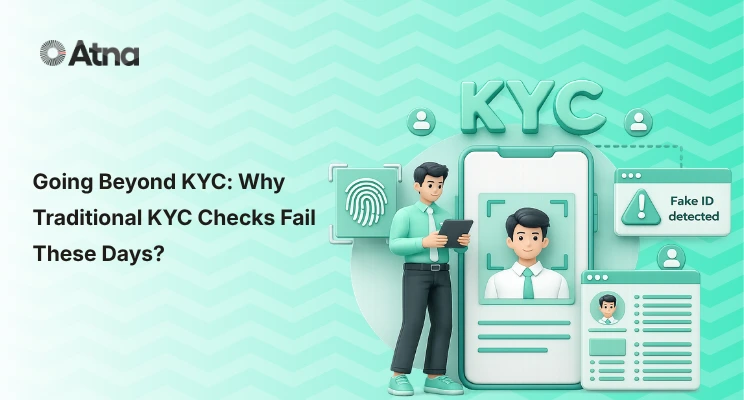
    Going Beyond KYC: Why Traditional Checks Fail Today

    Introduction 

    For years, KYC (Know Your Customer) has served as the foundation of customer onboarding and regulatory compliance across banking, fintech, insurance, and digital platforms. By verifying customer identities through official documents and basic checks, organizations aimed to prevent fraud, money laundering, and financial crimes. 

    However, the digital landscape has changed dramatically. Fraudsters now leverage artificial intelligence, deepfakes, synthetic identities, and sophisticated account takeover techniques that can easily bypass traditional verification methods. As a result, organizations are increasingly asking, Why traditional KYC is no longer enough? 

    The answer lies in the growing gap between static identity verification and dynamic fraud prevention. Today, businesses need continuous identity validation, real-time risk assessment, and advanced fraud detection capabilities that go beyond conventional KYC processes. 

    What is KYC? 

    Know Your Customer (KYC) refers to the process organizations use to verify the identity of customers before providing financial services or granting access to digital platforms. 

    Traditional KYC typically includes: 

    • Identity document verification 
    • Address verification 
    • Facial matching 
    • Database checks 
    • Regulatory compliance screening 

    While these measures remain important, they are often conducted only during onboarding. Once a customer account is approved, ongoing identity verification is rarely performed. 

    This limitation is one of the primary reasons why traditional KYC is no longer enough in today’s rapidly evolving threat landscape. 

    What Are the Frauds That Bypass Basic KYC? 

    Modern fraudsters have become highly sophisticated, exploiting weaknesses in static verification processes. 

    Synthetic Identity Fraud 

    Criminals create entirely new identities by combining genuine information with fabricated details. These synthetic identities often appear legitimate during standard KYC checks. 

    Account Takeover (ATO) 

    Fraudsters gain access to legitimate customer accounts through phishing attacks, credential theft, SIM swapping, or malware. Since the original KYC was completed successfully, traditional systems often fail to detect the compromise. 

    Authorized Push Payment (APP) Fraud 

    Victims are manipulated into transferring funds willingly, making the transaction appear legitimate despite fraudulent intent. 

    Identity Theft 

    Stolen personal information can be used to open accounts, apply for loans, or access financial services while passing basic verification procedures. 

    These growing threats highlight why traditional KYC is no longer enough to protect businesses and consumers. 

    What Are AI-Powered Frauds? 

    Artificial Intelligence has transformed many industries—but it has also empowered cybercriminals. 

    Deepfake Attacks 

    AI-generated videos and images can mimic real individuals with remarkable accuracy, deceiving facial recognition systems and identity verification tools. 

    AI Voice Cloning 

    Fraudsters can replicate a person’s voice to impersonate customers, executives, or support agents. 

    Automated Fraud Networks 

    Machine learning algorithms help attackers scale fraudulent activities while adapting to security controls in real time. 

    AI-Generated Synthetic Identities 

    Advanced AI can generate realistic identity documents, profile pictures, and supporting information that appear authentic during onboarding checks. 

    The increasing sophistication of these attacks demonstrates why traditional KYC is no longer enough for modern fraud prevention. 

    Why Traditional Checks Fail These Days 

    Static Verification Cannot Stop Dynamic Threats 

    Traditional KYC validates customers at a single point in time. Fraud risks, however, evolve continuously after onboarding. 

    No Visibility After Account Creation 

    Most financial crimes occur after accounts are opened. Basic KYC offers little protection against account takeovers or behavioral anomalies. 

    Deepfakes Bypass Conventional Verification 

    AI-generated images and videos can fool traditional facial recognition systems that rely on simple matching techniques. 

    Synthetic Identities Look Legitimate 

    Modern synthetic identities often contain enough genuine information to pass document verification and database checks. 

    Limited Behavioral Intelligence 

    Traditional systems focus on documents rather than customer behavior, device intelligence, transaction patterns, and risk signals. 

    Regulatory Expectations Are Evolving 

    Regulators increasingly require continuous monitoring, periodic KYC updates, and perpetual KYC frameworks rather than one-time verification. 

    These challenges clearly explain why traditional KYC is no longer enough to safeguard today’s digital ecosystems. 

    How Atna Helps Combat AI-Powered Frauds 

    Atna helps organizations move beyond static verification by implementing intelligent identity assurance and continuous risk management. 

    Rather than relying solely on documents, Atna creates a comprehensive trust framework that continuously validates customer authenticity throughout the customer lifecycle. 

    This approach addresses a key industry concern: Why traditional KYC is no longer enough in the age of AI-powered fraud. 

    What Atna Has to Offer 

    Atna delivers advanced identity verification and fraud prevention capabilities designed for today’s digital-first businesses. 

    End-to-End Identity Assurance 

    Verify identities with greater confidence through multiple layers of validation. 

    Continuous Risk Monitoring 

    Track evolving customer risk profiles beyond onboarding. 

    Fraud Intelligence Framework 

    Detect suspicious behaviors before financial losses occur. 

    Compliance-Ready Infrastructure 

    Support evolving regulatory requirements related to KYC, AML, and perpetual customer monitoring. 

    Scalable Digital Onboarding 

    Enable secure customer acquisition without sacrificing user experience. 

    Key Features of Atna That Help the Industry Combat AI-Powered Fraud 

    Advanced Liveness Detection 

    Detect presentation attacks, spoofing attempts, and deepfake-generated identities during verification. 

    AI-Powered Fraud Analytics 

    Identify hidden fraud patterns using behavioral intelligence and risk scoring models. 

    Continuous Identity Validation 

    Monitor identities throughout the customer journey rather than relying on a single verification event. 

    Device Intelligence 

    Analyze device signals, geolocation patterns, and access behavior to identify suspicious activity. 

    Behavioral Monitoring 

    Track unusual transaction patterns and customer behavior to detect account takeover attempts. 

    Dynamic Risk Profiling 

    Create living customer profiles that evolve as new information and activities emerge. 

    Regulatory Compliance Support 

    Facilitate ongoing compliance with KYC, AML, and perpetual KYC requirements. 

    Real-Time Fraud Detection 

    Enable immediate responses to high-risk activities before fraud losses occur. 

    Conclusion 

    The digital fraud landscape has evolved far beyond the capabilities of traditional onboarding checks. Deepfakes, synthetic identities, account takeovers, and AI-powered fraud schemes have exposed the limitations of static verification processes. 

    Organizations can no longer depend solely on one-time document checks to establish trust. Instead, they must adopt continuous identity validation, behavioral intelligence, and dynamic risk monitoring to remain secure and compliant. 

    The question is no longer whether businesses should modernize their verification strategies. The real question is why traditional KYC is no longer enough—and how quickly organizations can implement stronger defenses against emerging threats. 

    With advanced identity assurance, continuous monitoring, and AI-driven fraud detection, Atna helps businesses stay ahead of modern fraud while building trust in every customer interaction. 

    FAQ’s

    01 What is KYC? +
    KYC (Know Your Customer) is the process of verifying a customer’s identity before providing financial or digital services.
    02 Why is traditional KYC no longer enough? +
    Traditional KYC relies on one-time verification and cannot effectively detect evolving threats such as deepfakes, account takeovers, and synthetic identities.
    03 What is a synthetic identity? +
    A synthetic identity combines real and fabricated information to create a seemingly legitimate customer profile used for fraud.
    04 What are deepfake attacks? +
    Deepfakes are AI-generated images, videos, or audio recordings designed to impersonate real individuals.
    05 How do fraudsters bypass basic KYC? +
    They use synthetic identities, stolen credentials, AI-generated documents, and deepfake technology to pass traditional checks.
    06 What is continuous identity validation? +
    It is the ongoing verification of customer identity through behavioral monitoring, device intelligence, and risk analysis.
    07 How does Atna help prevent AI-powered fraud? +
    Atna uses advanced fraud analytics, liveness detection, continuous monitoring, and dynamic risk profiling to identify and stop fraud.
    08 Why is perpetual KYC becoming important? +
    Perpetual KYC enables organizations to continuously assess customer risk and maintain compliance with evolving regulations.
  • Why AML and Fraud Intelligence Together Make the Strongest Onboarding Fraud Defense?

    Why AML and Fraud Intelligence Together Make the Strongest Onboarding Fraud Defense?

    In today’s digital-first economy, customer onboarding has become faster, more convenient, and increasingly automated. While these advancements improve customer experiences, they also create new opportunities for criminals seeking to exploit vulnerabilities in onboarding processes. Fraudsters are no longer operating with simple fake identities; they are leveraging sophisticated techniques to bypass verification controls, create synthetic identities, and gain access to financial systems.

    A critical reality often overlooked by organizations is that onboarding fraud and money laundering are deeply interconnected. Criminals rarely commit onboarding fraud for its own sake. Instead, fraudulent onboarding is often the first step in a larger scheme designed to move, conceal, or legitimize illicit funds. This is why organizations can no longer treat fraud detection and anti-money laundering (AML) programs as separate functions, when there is compliance involved. Metro Bank was fined approximately £16 million (US$20.5 million) by the UK regulator for failures in transaction monitoring and AML controls.

    The combination of Fraud Prevention & AML Compliance creates a powerful defense mechanism capable of identifying suspicious activities from the moment a customer attempts to enter the ecosystem.

    Understanding the Connection Between Onboarding Fraud and Money Laundering

    Money laundering involves disguising illegally obtained funds to make them appear legitimate. To achieve this, criminals need access to financial accounts, payment systems, trading platforms, lending services, or digital wallets.

    However, before illicit funds can be moved, criminals must first gain entry into these systems.

    This is where onboarding fraud comes into play.

    Fraudsters may:

    • Use stolen identities to open accounts
    • Create synthetic identities using real and fabricated information
    • Submit forged documents during onboarding
    • Manipulate verification processes
    • Use mule accounts to move illicit funds
    • Exploit weak Know Your Customer (KYC) controls

    Once these accounts are established, they become channels for laundering money, conducting financial fraud, or facilitating other criminal activities.

    Simply put, onboarding fraud is often the gateway that enables money laundering.

    Why Traditional Approaches Fall Short

    Historically, fraud teams and AML teams operated independently.

    Fraud departments focused on:

    • Identity verification
    • Account takeover prevention
    • Synthetic identity detection
    • Device and behavioral analysis

    AML departments focused on:

    • Transaction monitoring
    • Sanctions screening
    • Politically Exposed Person (PEP) checks
    • Suspicious activity reporting
    • Regulatory compliance

    While both functions serve important purposes, working in silos creates blind spots.

    For example, an account may successfully pass AML checks but originate from a synthetic identity. Similarly, a fraud monitoring system may flag suspicious onboarding activity, but without AML intelligence, the broader money laundering risks may go unnoticed.

    Criminals exploit these gaps.

    Organizations need a unified strategy that combines fraud intelligence with AML controls from the very beginning of the customer lifecycle.

    The Power of Fraud Prevention & AML Compliance Working Together

    When fraud intelligence and AML systems share data and insights, organizations gain a much clearer picture of customer risk.

    1. Detecting High-Risk Customers Before Account Creation

    Fraud intelligence evaluates factors such as:

    • Device reputation
    • Behavioral patterns
    • Identity inconsistencies
    • Velocity checks
    • Network analysis

    AML systems evaluate:

    • Sanctions lists
    • Watchlists
    • PEP databases
    • Adverse media findings
    • Jurisdictional risks

    By combining both perspectives, organizations can identify suspicious applicants before they gain access to services.

    2. Stopping Synthetic Identity Fraud

    Synthetic identities represent one of the fastest-growing threats in financial crime. Fraudsters combine legitimate information with fabricated details to create identities that appear authentic. These accounts often remain dormant initially and later become vehicles for large-scale fraud or money laundering activities. A combined Fraud Prevention & AML Compliance framework can identify inconsistencies across identity attributes, behavioral signals, document authenticity, and risk databases, significantly reducing synthetic identity risks.

      3. Identifying Mule Accounts Early

      Money mules play a crucial role in laundering criminal proceeds. Many mule accounts are opened using deceptive onboarding methods, stolen credentials, or recruited individuals. Fraud intelligence can detect unusual onboarding behaviors, while AML systems monitor financial activity patterns associated with mule networks. Together, they help identify suspicious accounts before significant damage occurs.

        4. Strengthening Risk-Based Onboarding

        Not all customers present the same level of risk. A risk-based onboarding strategy uses fraud and AML intelligence to assign risk scores during customer enrollment. Higher-risk applicants can be subjected to:

          • Enhanced due diligence
          • Additional identity verification
          • Manual reviews
          • Ongoing monitoring

          This approach improves security without negatively impacting legitimate customers.

          5. Improving Regulatory Compliance

          Regulators increasingly expect organizations to take a holistic approach to financial crime prevention. When fraud and AML teams collaborate, organizations can demonstrate stronger governance, better risk management, and more effective customer due diligence practices. Integrated controls also reduce false positives and improve operational efficiency, helping compliance teams focus on genuinely suspicious cases.

            Building a Unified Financial Crime Defense Strategy

            Modern onboarding security requires more than isolated verification checks.

            Organizations should implement:

            Real-time identity verification

            Document authentication

            Device intelligence

            Behavioral biometrics

            Sanctions and watchlist screening

            PEP screening

            Risk scoring engines

            Continuous transaction monitoring

            Network and relationship analysis

            By integrating these capabilities into a single onboarding framework, businesses can identify both fraud risks and money laundering threats before they escalate.

            Conclusion

            As financial crime becomes more sophisticated, the boundaries between fraud prevention and AML compliance continue to blur.

            Criminals use onboarding fraud as a tool to gain access to financial systems, while money laundering remains the ultimate objective behind many fraudulent activities. Organizations that treat these risks separately risk missing critical warning signs.

            The future belongs to organizations that embrace unified financial crime prevention strategies with tailored solutions offered by experts like Atna AI. By combining fraud intelligence with AML controls, businesses can stop criminals at the earliest stage of the customer journey, reduce regulatory exposure, and protect both their customers and their reputation.

            Ultimately, Fraud Prevention & AML Compliance is not just a regulatory necessity—it is the strongest defense against onboarding fraud and the illicit movement of funds. 

            01 Why is combining AML and fraud intelligence more effective during customer onboarding? +
            AML identifies financial crime risks while fraud intelligence detects suspicious identities and behaviors.
            Together, they create a stronger defense against onboarding fraud and compliance violations.
            02 How does AML help prevent onboarding fraud? +
            AML screening checks customers against sanctions lists, watchlists, and high-risk databases.
            This helps organizations identify risky individuals before accounts are approved.
            03 What role does fraud intelligence play in identity verification? +
            Fraud intelligence analyzes device, behavioral, and identity signals to uncover suspicious activity.
            It helps detect synthetic identities, stolen credentials, and account takeover attempts.
            04 Can integrated AML and fraud intelligence reduce false positives? +
            Yes, combining AML and fraud data provides more context for risk assessment.
            This improves decision accuracy and reduces unnecessary onboarding delays.
            05 Why is onboarding fraud prevention critical for financial institutions? +
            Preventing fraud at onboarding reduces financial losses, compliance risks, and reputational damage.
            It also helps build customer trust and strengthens long-term business security.
          1. Top 50 Fraud Detection Questions Answered by Atna Experts

            Top 50 Fraud Detection Questions Answered by Atna Experts

            Introduction

            Fraud is no longer a back-office problem, it’s a boardroom priority. 

            As financial crime grows more sophisticated, so does the technology built to stop it. From AI-generated deepfakes bypassing biometric checks to synthetic identities slipping through onboarding flows, the fraud landscape in 2025 demands smarter, faster, and more layered defenses than ever before. 

            Yet for every CISO, compliance head, risk officer, and developer trying to build the right stack, the same questions keep coming up. What actually works? How do fraud detection services differ from fraud prevention solutions? When does a KYB solution become necessary? How do deepfake detection solutions fit into a KYC workflow? And what does a genuinely ROI-positive fraud prevention and AML compliance program look like in practice? 

            We compiled the 50 most searched questions from industry forums, compliance communities, and risk practitioner networks spanning fraud detection services, KYC verification, KYB solutions, digital footprinting, customer risk scoring, deepfake detection, and AML compliance and answered every single one.

            Whether you’re evaluating vendors, building an internal risk function, or trying to understand where your current stack has gaps, this is the reference guide the industry has been asking for. 
             

            Top 50 industry-driven questions that Atna AI experts answered 

              
            Q1. What are fraud detection services and how do they work?  
             
            Fraud detection services use AI, machine learning, and behavioral analytics to identify suspicious patterns in real-time transactions, onboarding flows, and customer behavior. Modern fraud detection solutions analyze thousands of data signals device fingerprints, IP reputation, transaction velocity, and identity mismatches to flag or block fraudulent activity before it causes financial loss. 

            Q2. What’s the difference between fraud detection and fraud prevention solutions? 

            Fraud detection identifies fraud as it happens or after the fact, while fraud prevention solutions stop it before it occurs. The most effective platforms combine both — using real-time risk scoring during onboarding and transactions, plus ongoing monitoring to catch emerging fraud patterns early. 

            Q3. Which industries need fraud detection services the most? 

            Insurance, banking, fintech, lending, and e-commerce rely most heavily on fraud detection services. Insurance fraud detection is particularly critical, with claims fraud costing the industry billions annually. Other high-need sectors include crypto exchanges, digital wallets, and regulated financial services requiring AML compliance. 

            Q4. How accurate are AI-powered fraud detection solutions? 

            Leading AI-powered fraud detection solutions achieve 95–99%+ accuracy by combining supervised ML models with real-time behavioral signals. Accuracy depends heavily on model training data, feature richness (e.g., digital footprinting, device intelligence), and how frequently the model is retrained against new fraud patterns. 

            Q5. What data does a fraud detection service use to flag risk? 

            Fraud detection services draw on identity data, device fingerprints, IP geolocation, email age and activity, phone carrier signals, behavioral biometrics, transaction history, and social graph analysis. The richer the data stack, the lower the false positive rate — meaning fewer genuine customers are incorrectly blocked. 

            Q6. Can fraud detection solutions work in real time? 

            Yes. Real-time fraud detection solutions deliver risk decisions in milliseconds via API, enabling businesses to accept, flag, or reject users and transactions at the point of action — during login, payment, account creation, or insurance claims submission — without adding friction for legitimate users. 

            Q7. What is the cost of fraud detection services? 

            Fraud detection service pricing typically follows API call volume, with enterprise plans priced on monthly active users or transaction count. Mid-market platforms range from a few hundred to several thousand dollars monthly. The ROI is typically measured against fraud losses prevented and manual review costs reduced. 

            Q8. How do fraud detection solutions reduce false positives? 

            Reducing false positives requires layered signals — not just single-point checks. The best fraud prevention solutions combine behavioral analytics, device intelligence, and risk scoring with configurable thresholds so businesses can tune sensitivity based on their risk appetite without blocking good customers. 

            Q9. What’s the difference between rule-based and AI-based fraud detection? 

            Rule-based fraud detection uses fixed logic (e.g., “flag transactions over $10,000 from new accounts”) — fast but rigid. AI-based fraud detection solutions learn continuously from patterns, adapting to new fraud tactics in ways static rules cannot. Most modern platforms use a hybrid approach. 

            Q10. How do fraud detection services handle new or synthetic fraud patterns? 

            Advanced fraud detection services use unsupervised machine learning and anomaly detection to identify never-before-seen fraud patterns — including synthetic identity fraud, where fraudsters combine real and fake data. Digital footprinting solutions play a key role here by detecting inconsistencies invisible to traditional ID checks. 

            Q11. Can fraud detection solutions integrate with existing systems? 

            Yes. Enterprise fraud detection solutions offer REST APIs and webhooks that integrate with CRMs, core banking systems, insurance platforms, and onboarding workflows. Low-code SDKs and no-code connectors (Zapier, Make) reduce integration timelines from weeks to days. 

            Q12. What compliance standards do fraud detection services support? 

            Fraud detection and AML compliance platforms typically align with GDPR, CCPA, PCI-DSS, FATF guidelines, and local financial regulations. Built-in audit trails, data residency options, and explainable AI outputs help compliance teams satisfy regulatory requirements without manual documentation overhead. 

            Q13. What is AML compliance and why does it matter? 

            AML (Anti-Money Laundering) compliance refers to the legal and operational processes financial institutions use to detect, report, and prevent money laundering. Fraud prevention and AML compliance solutions automate transaction monitoring, suspicious activity reporting (SAR), and customer risk scoring to meet regulatory obligations efficiently. 

            Q14. How are fraud prevention and AML compliance connected? 

            Fraud prevention and AML compliance overlap significantly — both require real-time risk assessment, identity verification, and behavioral monitoring. Integrated platforms that combine fraud signals with AML watchlist screening give compliance teams a unified risk picture instead of siloed tools. 

            Q15. What is transaction monitoring in AML compliance? 

            Transaction monitoring is the process of continuously reviewing financial activity to detect patterns indicative of money laundering, terrorism financing, or fraud. AML compliance platforms automate this with configurable rules and ML models that reduce manual review workloads while improving detection rates. 

            Q16. What triggers a suspicious activity report (SAR)? 

            SARs are triggered when fraud detection or AML compliance systems identify transactions or behaviors that suggest illegal activity — structuring, unusual wire transfers, high-volume cash activity, or mismatches between stated purpose and actual behavior. Automated fraud prevention solutions flag these for compliance officer review. 

            Q17. How does customer risk scoring work in AML? 

            Customer risk scoring assigns a dynamic risk tier (low/medium/high) to each customer based on identity attributes, transaction behavior, geographic exposure, PEP/sanctions status, and historical patterns. Fraud prevention and AML compliance platforms update scores continuously, triggering enhanced due diligence when risk elevates. 

            Q18. What is enhanced due diligence (EDD)? 

            Enhanced due diligence is a deeper level of customer verification required for high-risk individuals and entities. It typically includes source of funds verification, adverse media screening, and more frequent review cycles. Fraud prevention solutions automate EDD workflows for customers flagged by customer risk scoring systems. 

            Q19. Can small fintechs afford AML compliance solutions? 

            Yes. Modern AML compliance platforms offer usage-based pricing that scales with transaction volume, making them accessible to early-stage fintechs. The real cost of non-compliance — regulatory fines, license revocation, reputational damage — far exceeds the investment in a proper fraud prevention and AML compliance stack. 

            Q20. What’s the difference between KYC and AML compliance? 

            KYC (Know Your Customer) is the identity verification component — confirming who a customer is at onboarding. AML compliance is the ongoing process — monitoring behavior, screening against watchlists, and reporting suspicious activity. Both are required together; KYC verification services feed customer data into AML monitoring workflows. 

            Q21. How do fraud prevention solutions handle PEP and sanctions screening? 

            Fraud prevention and AML compliance platforms integrate with global PEP (Politically Exposed Person) and sanctions databases — OFAC, UN, EU, HM Treasury — screening customers at onboarding and on an ongoing basis. Automated alerts flag matches for manual review, with full audit trails for regulatory evidence. 

            Q22. What is the role of AI in AML compliance? 

            AI in AML compliance reduces false positive rates (which average 95%+ in rule-based systems), adapts to evolving laundering typologies, and automates case prioritization. Machine learning models trained on labeled fraud and AML data dramatically improve the signal-to-noise ratio for compliance teams. 

            Q23. What is KYC verification and what does it involve? 

            KYC (Know Your Customer) verification confirms a customer’s identity using government-issued ID, biometric checks, liveness detection, and data cross-referencing. KYC verification services are mandatory for banks, fintechs, insurers, and any regulated entity onboarding new customers. 

            Q24. What is a KYB solution and how does it differ from KYC? 

            A KYB (Know Your Business) solution verifies the identity and legitimacy of a business entity — including UBO (Ultimate Beneficial Owner) mapping, company registry checks, and adverse media screening. KYC verification services focus on individuals; KYB solutions focus on corporate clients and are essential for B2B onboarding in financial services. 

            Q25. How fast can KYC verification services onboard a customer? 

            Modern KYC verification services using automated document checks and AI-powered liveness detection can complete onboarding in under 60 seconds. End-to-end automation — from ID capture to identity match to risk scoring — eliminates manual review bottlenecks for the majority of applicants. 

            Q26. What is digital footprinting and how does it detect fraud? 

            Digital footprinting solutions analyze the passive signals left by a user’s online presence — email age, social media activity, domain registration history, phone number usage, and device behavior — to build a trust score. A thin or inconsistent digital footprint is a strong indicator of synthetic identity or first-party fraud. 

            Q27. How do digital footprinting solutions complement traditional KYC? 

            Traditional KYC verification checks documents and selfies. Digital footprinting solutions add a behavioral and reputational layer — verifying whether the identity behind the document has a credible, consistent online history. Together, they catch fraudsters who pass document checks using stolen or synthetic identities. 

            Q28. What is UBO mapping in a KYB solution? 

            UBO (Ultimate Beneficial Owner) mapping traces the ownership chain of a business entity to identify individuals who own 25%+ of shares or exercise significant control. KYB solutions automate this process using global company registries, reducing the weeks-long manual research required for complex corporate structures. 

            Q29. What is deepfake detection and why is it relevant to KYC? 

            Deepfake detection solutions identify AI-generated synthetic media — manipulated videos, voice clones, and face swaps — used to bypass liveness checks in KYC verification. As deepfake technology becomes widely accessible, deepfake detection is becoming a core requirement for any biometric-based onboarding workflow. 

            Q30. How do deepfake detection solutions work technically? 

            Deepfake detection solutions use a combination of computer vision models, liveness analysis, physiological signal detection (micro-blinking, skin texture), and metadata forensics to distinguish genuine video from AI-generated content. The best solutions are trained on continuously updated datasets of emerging deepfake methods. 

            Q31. What is customer risk scoring and how is it used in onboarding? 

            Customer risk scoring assigns a real-time risk rating to each new user based on identity signals, digital footprint, device characteristics, and behavioral patterns during onboarding. High-risk scores trigger step-up verification or manual review, while low-risk users pass through frictionlessly — balancing security and conversion. 

            Q32. Can KYB solutions handle international company verification? 

            Yes. Enterprise KYB solutions access company registries, beneficial ownership databases, and adverse media sources across 100+ countries, enabling global business onboarding. Cross-border KYB is particularly important for correspondent banking, trade finance, and global insurance platforms. 

            Q33. What is eKYC and how does it differ from manual KYC? 

            eKYC (electronic KYC) is the fully digital, automated version of identity verification — using AI document processing, biometric matching, and database cross-referencing instead of in-branch checks. eKYC verification services reduce onboarding costs by 60–80% compared to manual processes while improving compliance accuracy. 

            Q34. How does customer risk scoring change post-onboarding? 

            Customer risk scoring is dynamic — not a one-time check. Post-onboarding, scores update based on transaction behavior, watchlist changes, adverse media events, and account activity patterns. This continuous scoring enables fraud prevention solutions to flag customers whose risk profile has changed since initial KYC. 

            Q35. What industries use KYB solutions most? 

            KYB solutions are most widely used in banking (correspondent banking, SME lending), insurance (commercial underwriting), fintech (B2B payment platforms), and crypto exchanges. Any business onboarding corporate clients with AML compliance obligations needs a KYB solution. 

            Q36. What is insurance fraud detection and what types does it cover? 

            Insurance fraud detection covers claims fraud (staged accidents, inflated medical bills), application fraud (misrepresented risk), ghost brokering, and internal fraud. AI-powered insurance fraud detection solutions analyze claims data, behavioral patterns, and third-party intelligence to flag suspicious cases before payouts are made. 

            Q37. How does AI improve insurance fraud detection over manual review? 

            AI-powered insurance fraud detection processes thousands of claims variables simultaneously — inconsistencies in injury patterns, duplicate claim submissions, social media cross-referencing, and network link analysis — at a scale and speed no human team can match. This reduces claim leakage while cutting investigation costs. 

            Q38. What is claims fraud and how prevalent is it? 

            Claims fraud occurs when policyholders or third parties deliberately misrepresent or fabricate claims. Industry estimates put insurance fraud at 10–15% of total claims costs globally. Fraud detection solutions with ML scoring and network analysis are the primary defense against claims fraud at scale. 

            Q39. Can fraud detection solutions catch organized fraud rings? 

            Yes. Advanced fraud detection solutions include network graph analysis that maps relationships between claimants, providers, and intermediaries — identifying organized fraud rings that individual transaction checks miss. This is particularly powerful in auto, health, and workers’ compensation insurance fraud detection. 

            Q40. How do deepfakes threaten insurance and financial services fraud? 

            Deepfake detection is becoming critical in financial services and insurance as fraudsters use AI-generated video to impersonate customers during video KYC, create fake evidence for claims, and synthesize voice for phone-based authentication bypass. Deepfake detection solutions are now a must-have layer in any identity verification stack. 

            Q41. What is the ROI of implementing fraud detection solutions? 

            The ROI of fraud detection solutions is typically measured as fraud losses prevented minus platform costs, plus operational savings from reduced manual review. Most enterprises report 3–8x ROI within the first year, with payback periods under 6 months when fraud rates exceed 0.5% of transaction volume. 

            Q42. How do I evaluate fraud detection vendors?

            When evaluating fraud detection services, assess: detection accuracy (true positive rate), false positive rate, API latency, coverage of your specific use case (insurance, KYC, payments), global data coverage, integration complexity, explainability of decisions, and compliance certifications. Always request a proof-of-concept on your own data. 

            Q43. What should I look for in a fraud prevention solution for insurance? 

            Look for insurance-specific fraud detection features: claims linkage analysis, medical billing pattern detection, geospatial inconsistency flagging, and integration with industry data consortia. Generic fraud prevention solutions often miss insurance-specific fraud typologies that purpose-built platforms catch by default. 

            Q44. How long does it take to integrate a fraud detection API? 

            Most modern fraud detection APIs offer REST endpoints with well-documented SDKs, enabling basic integration in 1–3 days. Full production deployment — including custom risk threshold configuration, webhook setup, and dashboard training — typically takes 2–4 weeks for enterprise environments. 

            Q45. What is payment fraud detection and how does it differ from identity fraud? 

            Payment fraud detection focuses on transaction-level anomalies — unusual amounts, mismatched geolocation, velocity abuse, and card-not-present fraud. Identity fraud detection focuses on who is transacting. The best fraud detection solutions combine both layers, linking identity risk signals to payment behavior for holistic protection. 

            Q46. How do fraud prevention solutions scale with business growth? 

            Cloud-native fraud detection services scale horizontally — handling millions of API calls per day without performance degradation. Usage-based pricing models mean costs scale proportionally with volume, and ML models improve in accuracy as they process more customer data over time. 

            Q47. What is the difference between fraud detection and risk scoring? 

            Fraud detection is binary — flagging specific events as fraudulent. Customer risk scoring is continuous — assigning a dynamic probability of fraud risk to users and transactions. Risk scoring feeds into fraud detection workflows, enabling tiered responses (approve, step-up verify, decline) rather than binary block/pass decisions. 

            Q48. How do fraud detection solutions handle GDPR and data privacy? 

            GDPR-compliant fraud detection services process only the minimum necessary personal data, provide data subject access and deletion mechanisms, and maintain lawful basis for processing (legitimate interest for fraud prevention). Look for solutions with EU data residency options and ISO 27001 certification. 

            Q49. What is the future of fraud detection technology? 

            The future of fraud detection solutions includes federated learning (training models across datasets without sharing raw data), large language model-based anomaly detection, real-time biometric continuous authentication, and cross-industry fraud consortia sharing signals. Deepfake detection solutions and digital footprinting will become baseline requirements across all regulated industries. 

            Q50. Why is digital footprinting becoming essential in fraud prevention? 

            As document fraud becomes easier with AI tools, digital footprinting solutions provide a fraud signal that is far harder to fake — a coherent, long-standing online presence. Fraudsters can produce synthetic IDs but cannot fabricate years of consistent digital behavior across email, social, device, and network signals. This makes digital footprinting one of the highest-signal inputs in modern customer risk scoring. 

            Conclusion

            The questions in this guide reflect where the industry is right now: moving from reactive, rules-based fraud detection toward proactive, AI-powered fraud prevention solutions that combine identity intelligence, behavioral signals, and real-time risk scoring into a single, explainable decision layer. 

            What’s clear from these 50 questions is that no single tool is enough. Effective fraud prevention requires KYC verification services that go beyond document checks, KYB solutions that unravel complex ownership structures, digital footprinting solutions that surface signals traditional ID checks miss, deepfake detection that keeps biometric onboarding honest, and AML compliance workflows that turn raw data into defensible regulatory evidence. 

            The organizations winning against fraud today aren’t the ones with the biggest teams  they’re the ones with the most connected intelligence. The right fraud detection services don’t just block bad actors; they do it without slowing down the good ones. 

            If these questions reflect the challenges your team is navigating, the answers don’t have to stay theoretical. The technology to solve them exists and it’s more accessible than most compliance and risk teams realize. 

            01 How can AI improve fraud detection accuracy in financial institutions? +
            AI analyzes large volumes of transactions in real time to identify suspicious patterns. This helps organizations detect fraud faster and reduce false positives.
            02 What are the biggest challenges in modern fraud prevention? +
            Evolving fraud tactics, increasing transaction volumes, and manual review limitations are key challenges. Organizations need adaptive, AI-driven systems to stay ahead of emerging threats.
            03 Can AI help reduce false positives in fraud monitoring? +
            AI uses behavioral analysis and contextual data to make more accurate decisions. This minimizes unnecessary alerts and improves investigation efficiency.
            04 How does real-time transaction monitoring help prevent fraud? +
            Real-time monitoring identifies suspicious activities as they occur rather than after the fact. This enables faster intervention and reduces potential financial losses.
            05 Why is explainable AI important in fraud detection? +
            Explainable AI provides clear reasons behind fraud risk scores and alerts. This improves trust, supports compliance requirements, and aids investigation teams.
          2. The Impact of Reducing Onboarding Fraud on BFSIs

            The Impact of Reducing Onboarding Fraud on BFSIs

            By mitigating Onboarding Fraud, BFSIs can build customer trust and enhance digital banking security. It helps to deter fraudulent account creation, identity theft, and financial fraud, making the onboarding process safer for legitimate customers.  

            Onboarding fraud minimization also helps BFSIs avoid financial loss and ensure compliance with KYC and AML laws. Advanced fraud detection technologies enable banks and financial institutions to detect suspicious activities in time and stop the activation of high-risk accounts.  

            Onboarding fraud prevention optimizes operations by minimizing manual verification processes and fraud investigations. It also helps BFSIs to provide quick, secure, and effortless customer onboarding while ensuring brand reputation and long-term success. 

            The Impact of Reducing Onboarding Fraud on BFSIs 

            Introduction 

            The Banking, Financial Services and Insurance (BFSI) industry is quickly moving towards digital transformation, presenting a more streamlined and convenient customer onboarding experience. But this digital transformation has also made them more vulnerable to advanced fraud schemes. Fraud attacks in financial services rise 63%; losses jump 64% 

            BFSIs are facing a growing issue of onboarding fraud, where fraudsters are exploiting fake identities, synthetic data, stolen credentials, and forged documents to access financial services without authorization.  

            Protecting customer trust, staying compliant with regulations, and avoiding financial losses can only be achieved if BFSIs take steps to reduce onboarding fraud. With the expanding trend of digital banking and remote onboarding, financial institutions are faced with the challenge of securing their onboarding processes and providing safe customer experience with advanced fraud prevention methods. 

            Understanding Onboarding Fraud in BFSIs 

            Onboarding Fraud in BFSIs is when fraudsters register and verify fake identities during the registration and verification process. Some of these fraud schemes include identity theft, synthetic identities, document fraud, and mule account creation.  

            As the banking sector goes digital, banks are faced with threats from criminals exploiting vulnerabilities in onboarding systems, especially digital lending and mobile financial services. Monzo was fined £21 million after failures in onboarding and risk assessment controls allowed over 34,000 high-risk customers to open accounts. In the absence of robust fraud prevention measures, BFSIs can onboard high-risk individuals who may go on to commit account takeover (ATO) attacks, fraudulent transactions, and money laundering. 

            Why Onboarding Fraud is a Major Concern for BFSIs 

            BFSIs deal with highly sensitive financial and customer information and are a perfect target for fraudsters. But the types of fraudulent onboarding can result in:   

            • Loss of finances due to fake accounts and fraudulent transactions.  
            • Penalties for non-compliance with KYC and AML requirements by regulators  
            • Loss of reputation and loss of customer trust. Damage to reputation and loss of customer trust.  
            • More time and money spent on fraud investigations and remediation. More time and money spent on fraud investigations and remediation.  
            • Money laundering risks and financial crimes risks  

            With evolving fraud patterns, BFSIs need to take proactive measures in strengthening the onboarding security to reduce the risk and keep their customers confident. 

            The Impact of Reducing Onboarding Fraud on BFSIs 

            Improved Customer Trust 

            Proper onboarding procedures help customers feel at ease that their personal and financial information is safe. By minimizing Onboarding Fraud, BFSIs can foster better customer relationships and enhance their long-term retention efforts. 

            Reduced Financial Losses 

            Unauthorized transactions, loan fraud, chargebacks and money laundering risks can be caused by fraudulent accounts. These monetary risks to BFSIs can be greatly mitigated through effective fraud prevention. 

            Stronger Regulatory Compliance 

            BFSIs have to adhere to stringent KYC and AML rules. By minimizing Onboarding Fraud, institutions can stay compliant and prevent legal issues and regulatory penalties. 

            Faster Digital Onboarding 

            BFSIs can leverage advanced fraud detection technologies to automate customer verification without compromising on security. This helps to optimize a user’s onboarding experience without delay. 

            Enhanced Brand Reputation 

            When financial institutions get hacked or someone is fraudulently added to the payroll list, their reputation can be compromised. Overall, BFSIs are seen as reliable, trustworthy, and dedicated to protecting their customers by taking proactive measures to prevent fraud. 

            Better Operational Efficiency 

            Automated fraud detection and identity verification alleviates the burden of compliance and fraud investigation staff. This enhances the operational efficiency and reduces the manual verification expenses. 

            Key Features of Effective Onboarding Fraud Prevention for BFSIs 

            AI-Powered Fraud Detection 

            AI continuously evaluates customer activity and transaction trends, and flags suspicious new user activity as it happens. 

            Identity Verification Solutions 

            The advanced identity verification suite validates government-issued IDs, biometrics and customer information to thwart identity fraud. 

            Behavioral Analytics 

            Behavioral monitoring allows detecting malicious user activity, bot attacks, and suspicious onboarding behavior. 

            Device and IP Intelligence 

            High risk devices and suspicious login locations are detected by device fingerprinting and IP analysis, respectively, and both are flagged as potential points of risk in fraud attempts. 

            Real-Time Risk Monitoring 

            BFSIs can use continuous monitoring to identify and prevent fraudulent onboarding before the approval. 

            AML and KYC Compliance Integration 

            Integrated compliance checks support compliance and mitigate risks at BFSIs during the onboarding process. 

            Multi-Factor Authentication 

            An extra layer of authentication like OTP verification and biometric checks enhances onboarding security. 

            Conclusion 

            The impact of reducing Onboarding Fraud on BFSIs goes beyond fraud prevention alone. It strengthens customer trust, enhances regulatory compliance, reduces financial risks, and improves operational efficiency. As digital financial services continue to expand, BFSIs must adopt advanced fraud prevention technologies to stay ahead of evolving threats. 

            By investing in secure onboarding solutions from industry innovators like Atna AI , BFSIs can deliver seamless customer experiences while protecting their platforms, reputation, and long-term growth in an increasingly digital financial ecosystem. 

            FAQ’s

            01 What is onboarding fraud in the BFSI sector? +
            Onboarding fraud occurs when fraudsters use stolen identities, synthetic identities, forged documents, or deepfakes to open accounts, access financial services, or bypass verification processes.
            02 Why is onboarding fraud a major concern for BFSIs? +
            Onboarding fraud can lead to financial losses, regulatory penalties, reputational damage, increased operational costs, and higher risks of money laundering and financial crime.
            03 How do synthetic identities contribute to onboarding fraud? +
            Synthetic identities combine real and fabricated information to create seemingly legitimate customer profiles that can evade traditional verification checks and enable fraudulent account creation.
            04 What are the benefits of reducing onboarding fraud? +
            Reducing onboarding fraud helps BFSIs minimize financial losses, improve customer trust, strengthen compliance, enhance operational efficiency, and reduce the risk of future fraud incidents.
            05 How can AI improve fraud detection during customer onboarding? +
            AI can analyze behavioral patterns, validate identities, detect anomalies, identify synthetic identities, and assess risk in real time, helping institutions stop fraud before accounts are activated.
            06 What role does continuous monitoring play after onboarding? +
            Continuous monitoring enables BFSIs to identify suspicious activities, evolving fraud risks, account takeovers, and unusual customer behavior even after successful onboarding.
            07 How does Atna help BFSIs reduce onboarding fraud? +
            Atna combines identity verification, deepfake detection, digital footprint intelligence, fraud analytics, and risk-based decisioning to identify and prevent onboarding fraud in real time.
            08 How does reducing onboarding fraud improve customer experience? +
            Effective fraud prevention enables faster onboarding for legitimate customers, reduces verification delays, and creates a secure and seamless customer journey.


          3. Costly Background Verification Mistakes and How Atna Fixes Them

            Costly Background Verification Mistakes and How Atna Fixes Them

            In today’s fast-paced hiring landscape, Background verification is no longer optional—it’s a necessity. Recruitment organizations rely on it to build trust, ensure compliance, and avoid costly hiring errors. However, despite its importance, many companies still make critical mistakes during the verification process, exposing themselves to fraud, reputational damage, and operational risks.

            10.13% of BFSI candidates showing credential discrepancies and 50% of banking scams committed by insiders, background verification is no longer optional. 

            This is where modern authenticity verification companies like Atna AI step in, not just to verify, but to prevent hiring disasters before they happen.

            Let’s break down the most common mistakes, their impact, and how Atna solves them.

            1. Ignoring Identity & Address Checks

            Problem

            Many organizations skip basic identity and address validation, assuming submitted documents are accurate.

            Impact

            Without proper verification, tracing employees during fraud or legal issues becomes difficult. This can lead to data theft, compliance violations, and security risks.

            Atna Solution

            Atna automates identity validation using AI-driven verification tools, ensuring real-time authentication and eliminating fake identities during Background verification.

            2. Skipping Criminal Record Checks

            Problem

            Companies often assume white-collar roles are low-risk and skip criminal screenings.

            Impact

            This weak process exposes organizations to legal liabilities, workplace safety issues, and reputational damage.

            Atna Solution

            Atna integrates nationwide and global criminal databases into its platform, helping organizations conduct deep and accurate Background verification checks instantly.

            3. Incomplete Employment Background Verification

            Problem

            Relying only on resumes without verifying past employment is a common mistake.

            Impact

            This leads to hiring underqualified or fraudulent candidates, impacting productivity and increasing hiring costs.

            Atna Solution

            Unlike traditional verification companies, Atna AI uses data-backed employment validation systems to detect discrepancies early and ensure hiring accuracy.

            4. Skipping Education Checks During Background Verification

            Problem

            Fake degrees and certifications are increasingly common, yet often overlooked.

            Impact

            Poor Background verification allows unqualified candidates into critical roles, affecting business performance and credibility.

            Atna Solution

            Atna leverages digital academic databases and AI-powered document validation to authenticate educational credentials seamlessly.

            5. Overlooking Moonlighting Risks

            Problem

            With remote work, employees may hold multiple jobs without disclosure.

            Impact

            Weak verification can result in conflicts of interest, productivity loss, and data breaches.

            Atna Solution

            Atna’s intelligent monitoring systems help detect employment overlaps, ensuring transparency and reducing hidden risks.

            6. Ignoring Reference Checks

            Problem

            Many companies skip professional reference checks to speed up hiring.

            Impact

            Without proper process, behavioral red flags and past performance issues remain hidden, leading to poor hires.

            Atna Solution

            Atna enables structured and automated reference verification workflows, helping organizations gain deeper candidate insights quickly.

            7. Missing Global Background Verification

            Problem

            In a global workforce, candidates may have international histories that go unchecked.

            Impact

            Incomplete verification can miss critical red flags, especially for remote or cross-border hires.

            Atna Solution

            Atna offers global verification capabilities, ensuring seamless cross-border checks—something leading Background verification companies must provide today.

            8. No Continuous Monitoring

            Problem

            Most organizations treat verification as a one-time activity.

            Impact

            Risks can emerge after hiring—fraud, misconduct, or compliance issues—leading to long-term damage.

            Atna Solution

            Atna provides continuous monitoring and alerts, transforming Background verification into an ongoing risk management system.

            9. Relying on Manual Background Verification Processes

            Problem

            Traditional verification methods are slow, error-prone, and inconsistent.

            Impact

            Manual verification delays hiring, increases costs, and introduces human errors.

            Atna Solution

            Atna automates the entire workflow using AI and APIs, making it one of the most efficient Background verification companies for modern hiring needs.

            Why Traditional Background Verification Is No Longer Enough

            The hiring landscape has evolved. With remote work, gig economy roles, and digital fraud on the rise, outdated verification methods simply cannot keep up. According to industry insights, even small gaps can lead to significant financial and reputational losses.

            One in four managers estimated their companies had lost more than $50,000 in the past year because of fraudulent hires

            Modern organizations need more than just checks—they need intelligence.

            How Atna Redefines Background Verification

            Atna goes beyond traditional methods by offering:

            • AI-powered automation
            • Real-time verification APIs
            • Fraud detection intelligence
            • Scalable verification workflows
            • Continuous monitoring systems

            Unlike conventional Background verification companies, Atna focuses on proactive risk prevention rather than reactive checks.

            The Future of Background Verification

            As hiring becomes more digital, Background verification is shifting from a compliance task to a strategic advantage. Companies that invest in smart verification systems gain:

            • Better hiring accuracy
            • Reduced fraud risk
            • Faster onboarding
            • Stronger employer branding

            Choosing the right partner among Background verification companies can make all the difference.

            Conclusion

            Mistakes in Background verification are not just operational gaps—they are business risks. From identity fraud to fake credentials, every unchecked detail can lead to costly consequences.

            By addressing these challenges with intelligent solutions, Atna AI ensures your hiring process is not just faster—but smarter and safer.

            If your organization is still relying on outdated methods, it’s time to rethink your approach to Background verification and partner with a solution built for the future.

            FAQ’s

            01 What are the most common background verification mistakes businesses make? +
            Common mistakes include relying on manual verification processes, using outdated data sources, performing one-time checks only, and failing to verify digital identities and behavioral signals.
            02 Why can incomplete background checks increase fraud risk? +
            Incomplete checks can miss identity inconsistencies, criminal records, employment discrepancies, and fraudulent documentation, allowing high-risk individuals to bypass screening processes.
            03 How do manual verification processes create operational challenges? +
            Manual processes are time-consuming, prone to human error, difficult to scale, and can delay onboarding, hiring, or customer verification decisions.
            04 What role does AI play in modern background verification? +
            AI helps automate identity checks, analyze large datasets, detect anomalies, identify fraud patterns, and improve verification accuracy in real time.
            05 How can organizations identify fraudulent identities during verification? +
            Organizations can use identity intelligence, document validation, behavioral analytics, device fingerprinting, and risk-scoring technologies to uncover suspicious activities.
            06 Why is continuous monitoring important after verification? +
            Risks can emerge after initial verification. Continuous monitoring helps organizations detect changes in behavior, emerging fraud signals, and evolving compliance risks.
            07 How does Atna improve background verification processes? +
            Atna combines AI-powered risk intelligence, identity verification, fraud detection, digital footprint analysis, and continuous monitoring to deliver faster and more accurate verification outcomes.
            08 How can businesses reduce verification costs while improving accuracy? +
            By automating verification workflows, leveraging AI-driven analytics, and continuously monitoring risk, businesses can reduce manual effort, improve accuracy, and lower operational costs.


          4. Rethinking Evidence Verification in the Age of AI

            Rethinking Evidence Verification in the Age of AI

            In an era where artificial intelligence is rapidly reshaping industries, the concept of “evidence” is undergoing a profound transformation as document verification is more about authenticity. Nearly half of investigators report encountering digital evidence in 80–100% of cases, which can be easily manipulated. How? Due to the rise of deepfakes. From identity verification and financial transactions to legal documentation and digital communications, the way we collect, validate, and trust evidence is no longer what it used to be. Traditional verification methods, once considered robust, are now being challenged by the sophistication of AI-powered manipulation and fraud, making deepfake detection in documents a necessity. 

            As AI continues to evolve, organizations must rethink how they approach evidence verification, not just as a compliance requirement but as a strategic necessity for trust, security, and resilience. 

            The Changing Nature of Document Verification 

            Historically, evidence was tangible, static, and relatively easy to authenticate. Physical documents, handwritten signatures, and in-person verification processes created a strong chain of trust. Even in the early days of digitization, scanned documents and basic identity checks were sufficient. 

            Today, however, evidence is predominantly digital—and increasingly dynamic. Digital identities, online transactions, remote onboarding, and virtual interactions have become the norm. While this shift has brought efficiency and scalability, it has also introduced new vulnerabilities. 

            AI has enabled the creation of highly convincing fake identities, synthetic media, and manipulated documents. For example, deepfakes can replicate human faces and voices with startling accuracy, making it difficult to distinguish between genuine and fabricated evidence. Deepfake scams caused approximately $1.1 billion in global losses in 2025. Similarly, AI-generated documents can mimic official formats, logos, and signatures, bypassing traditional verification checks. 

            Thus, the document verifications for evidence are considered as a critical process 

            The Rise of AI-Powered Fraud 

            Fraudsters are leveraging AI at an unprecedented scale. Automated tools can now generate fake profiles, create synthetic identities by blending real and fabricated data, and even simulate behavioral patterns to appear legitimate. 

            This has significant implications for industries such as banking, fintech, e-commerce, and insurance, where document verification is a critical component of onboarding and transaction monitoring. One-time verification processes, such as traditional KYC (Know Your Customer), are no longer sufficient to mitigate these risks. 

            AI-driven fraud is not only more sophisticated but also more scalable. What once required manual effort can now be executed in bulk, allowing bad actors to exploit systems faster than ever before. 

            Limitations of Traditional Verification Methods 

            Most conventional document verification systems rely on static checks—document validation, database lookups, or rule-based risk scoring. While these methods are effective against basic fraud, they fall short in detecting advanced AI-driven threats. 

            Some key limitations include: 

            • Static Validation: One-time checks fail to account for changes over time or evolving risk profiles.  
            • Surface-Level Analysis: Traditional systems often focus on visible attributes (e.g., document authenticity) without analyzing deeper behavioral or contextual signals.  
            • Delayed Detection: Fraud is often identified after the damage has been done, rather than being prevented in real time.  
            • Siloed Data: Lack of integration across systems limits the ability to build a comprehensive risk profile.  

            These gaps highlight the need for a more dynamic and intelligent approach to evidence verification. 

            From Verification to Continuous Trust 

            To address these challenges, organizations must shift from static document verification to deepfake detection in documents with trust models. This involves monitoring and validating evidence throughout the entire lifecycle of a user or transaction, rather than relying on a single checkpoint. 

            Continuous verification leverages real-time data, behavioral analytics, and AI-driven insights to assess risk dynamically. For example: 

            • Monitoring user behavior to detect anomalies  
            • Analyzing device and network signals for inconsistencies  
            • Continuously updating risk scores based on new information  
            • Cross-referencing multiple data sources to validate authenticity  

            This approach not only enhances security but also improves user experience by reducing friction for legitimate users. 

            The Role of AI in Strengthening the Document Verification Process 

            While AI introduces new risks, it also offers powerful tools to combat them. When used responsibly, AI can significantly enhance evidence verification by deepfake detection in the document process. 

            1. Advanced Pattern Recognition 

            AI can analyze vast amounts of data to identify patterns that are invisible to human analysts. This includes detecting subtle inconsistencies in documents, identifying unusual user behavior, and recognizing fraud signatures. 

            2. Real-Time Risk Scoring 

            Machine learning models can assess risk in real time, enabling organizations to make faster and more accurate decisions. This is particularly valuable in high-volume environments such as financial transactions or online onboarding. 

            3. Digital Footprinting 

            AI can aggregate and analyze digital footprints—such as online presence, social signals, and historical activity—to build a comprehensive identity profile. This helps validate whether a user’s digital identity aligns with their claimed identity. 

            4. Synthetic Identity Detection 

            By analyzing data relationships and anomalies, AI can identify synthetic identities that may appear legitimate on the surface but exhibit inconsistencies at a deeper level. 

            Building a Future-Ready Document Verification Framework with Atna AI 

            To effectively navigate the age of AI, organizations need to adopt a holistic and future-ready approach to evidence of verification. This involves integrating technology, processes, and governance into a cohesive framework. Considering all these metrics, Atna AI offers a systematic framework for document verification, especially for legal evidence checks, through its product TRU. Docs 

            1. Multi-Layered Verification 

            Relying on a single method is no longer sufficient. Organizations should implement multiple layers of verification, combining document checks, biometric authentication, behavioral analysis, and digital footprinting. 

            2. Real-Time Intelligence 

            Verification systems should be capable of processing and analyzing data in real time, enabling proactive risk mitigation rather than reactive responses. 

            3. Interoperability and Integration 

            Seamless integration across systems and data sources is essential for building a unified view of risk. APIs and modular platforms can help organizations embed document verification capabilities into existing workflows. 

            4. Explainability and Transparency 

            As AI becomes a core component of document verification, it is crucial to ensure that decision-making processes are transparent and explainable. This not only builds trust but also supports regulatory compliance. 

            5. Continuous Learning 

            AI models must be continuously updated and trained to adapt to evolving threats. This requires ongoing data collection, feedback loops, and model optimization. 

            Balancing Security and User Experience 

            One of the biggest challenges in evidence of verification is striking the right balance between security and user experience. Overly stringent verification processes can create friction, leading to customer drop-offs and dissatisfaction. On the other hand, weak verification can expose organizations to significant risks. 

            AI can help achieve this balance by enabling adaptive verification, where the level of scrutiny is adjusted based on the risk profile of the user or transaction. Low-risk users can enjoy a seamless experience, while high-risk cases are subjected to more rigorous checks. 

            Ethical and Regulatory Considerations 

            As document verification systems become more sophisticated, ethical and regulatory considerations become increasingly important. Issues such as data privacy, bias in AI models, and consent must be carefully addressed. 

            Organizations must ensure that their verification practices comply with relevant regulations and uphold ethical standards. This includes: 

            • Protecting user data and ensuring privacy  
            • Avoiding discriminatory or biased outcomes  
            • Providing users with transparency and control over their data  

            The Road Ahead 

            The age of AI is redefining what it means to trust evidence. As the line between real and synthetic continues to blur, organizations must move beyond traditional verification methods and embrace a more dynamic, intelligent, and continuous approach. 

            Evidence verification is no longer just about validating documents; it’s about establishing trust in a digital-first world. Atna AI leverages AI responsibly, adopts continuous verification models, and builds robust frameworks so that organizations can stay ahead of emerging threats while delivering secure and seamless experiences. 

            In this rapidly evolving landscape, the ability to verify evidence effectively will not just be a competitive advantage; it will be a fundamental requirement for survival.  
             

            FAQ’s

            01 What is evidence verification? +
            Evidence verification is the process of validating the authenticity, accuracy, and reliability of documents, images, videos, and other digital records used in investigations, compliance, and decision-making.
            02 Why is evidence verification becoming more challenging in the age of AI? +
            AI technologies can generate realistic images, videos, audio recordings, and documents, making it increasingly difficult to distinguish authentic evidence from manipulated or fabricated content.
            03 What are deepfakes and how do they affect evidence verification? +
            Deepfakes are AI-generated media designed to mimic real people or events. They can create misleading evidence, increasing the risk of fraud, misinformation, and identity impersonation.
            04 Can AI help detect manipulated evidence? +
            Yes. Advanced AI models can analyze metadata, visual inconsistencies, behavioral patterns, and digital fingerprints to identify signs of tampering or synthetic content.
            05 What risks arise from relying solely on manual evidence review? +
            Manual reviews are often slow, resource-intensive, and susceptible to human error, making it easier for sophisticated fraudulent content to go undetected.
            06 How can organizations strengthen their evidence verification process? +
            Organizations can combine AI-powered analysis, identity verification, document authentication, digital footprint intelligence, and continuous monitoring to improve verification accuracy.
            07 How does Atna support evidence verification? +
            Atna helps organizations verify identities, detect deepfakes, analyze digital footprints, assess risk signals, and identify suspicious activity through AI-powered fraud intelligence.
            08 What is the future of evidence verification? +
            The future of evidence verification will rely on a combination of AI-driven validation, real-time risk assessment, continuous monitoring, and advanced fraud detection technologies to combat increasingly sophisticated threats.
          5. Are Deepfake Document Fraud Disrupting Your Claims Process?

            Are Deepfake Document Fraud Disrupting Your Claims Process?

            Claims were once highly document-driven. Every process workflow in an insurance company depends upon the documents that they collect from the insurer. Before the AI era, what seemed flawless has now become a highly risk-prone area. 

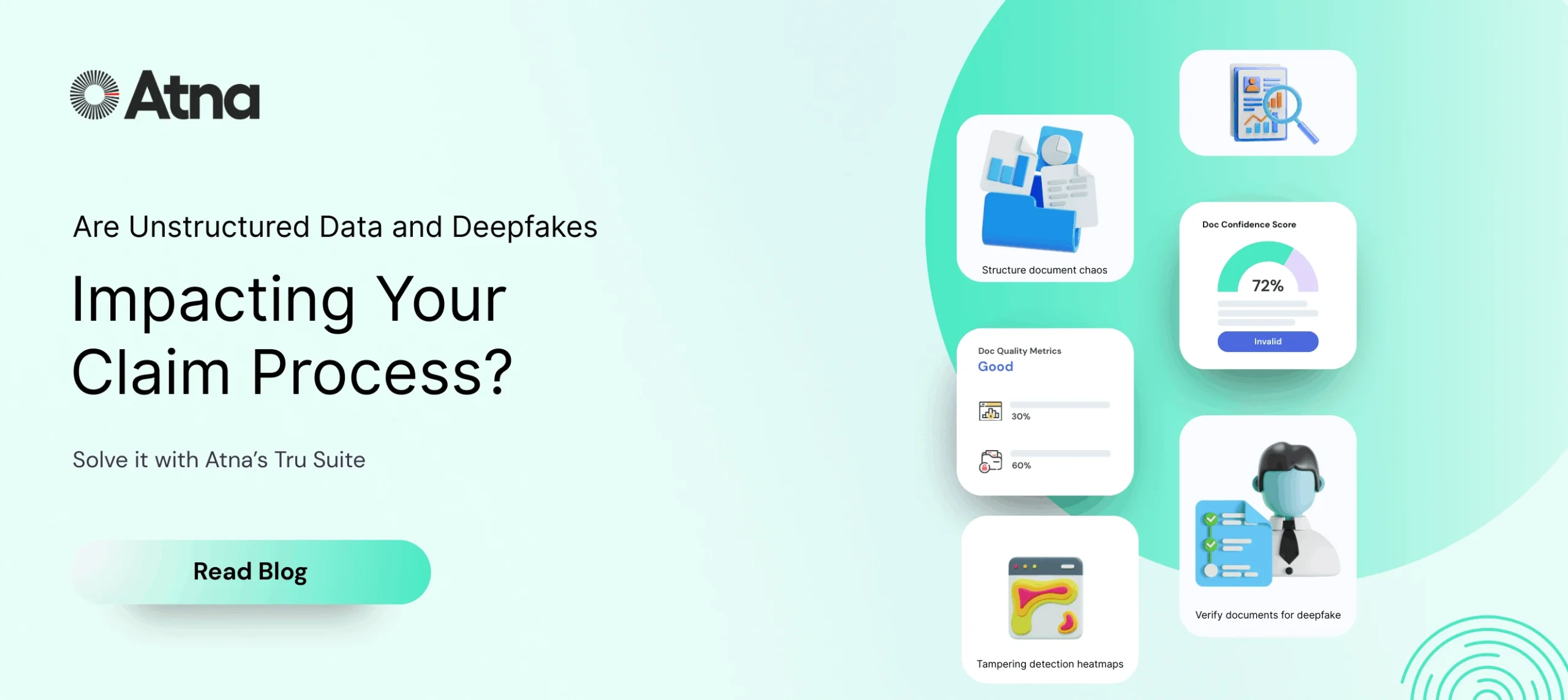
            The rise of document deepfakes has changed the narrative. Once a controlled and streamlined process, it has now become a high-risk-prone area in the insurance sector. The influencers are unstructured data and deepfake-driven document fraud

            These two factors pose a serious operational hindrance. Any organization that runs its revenue on such documents is running towards implementing a robust TrustOps architecture to combat deepfake document fraud. The deepfake impact is higher, reaching losses in the hundreds of billions, as UNESCO took to quote. 

            “We are approaching a synthetic reality threshold—a point beyond which humans can no longer distinguish authentic from fabricated media without technological assistance.” 

            Slower claims and process interruptions are draining the revenue, leaving organizations no time for a breather. This blog highlights the structural impact of claims, increasing disputes, and quietly draining revenue. For insurance leaders, these are no longer back-office issues; they are enterprise-level concerns that directly affect profitability and trust. 

            The Two Big Setbacks for Insurance: Unstructured Data and Deepfakes 

            Documentation is what insurance is all about. Claims are made based on the validity, wholeness, and truth of documents provided by policyholders and third parties. Nevertheless, the vast majority of these documents come in unstructured forms in PDFs, scanned images, handwritten notations, emails, and photographs.  

            Meanwhile, recent generative AI developments have enabled creating more convincing-looking documents than ever before that can pass across records and evade conventional verification. Fake medical records, AI-generated bills, and forged identity papers are no longer a case of edge cases; it is now being incorporated into the spectrum of fraud schemes.  

            What has been achieved is a claims environment in which there has been an increase in volume, a decrease in clarity, and a multiplied risk. 

            The Growing Burden of Claim Documentation 

            One insurance claim may include dozens of documents that are provided in the course of time by various sources. It is projected that claims teams should be able to read, interpret, validate, and correlate all of them and make a decision. 

             This paper-bound system is cumbersome at every level: 

            • Claims handlers take a longer period of time examining documents than assessing risk. 
            • Critical information is overlooked because of exhaustion or lack of uniformity. 
            • Cross-document discrepancies are not easy to notice. 
            • The indicators of fraud are concealed in document noise. 

            This burden cannot be taken with the increasing claim volumes. Expanding operations without looking into the complexity of documents will only increase the inefficiency. 

            The Impact on Insurance Firms 

            1. Unstructured Data Leads to Longer Claim Cycles 

            Systems are unable to analyze unstructured documents. Human interpretation renders slow claim processing and inconsistency

            This leads to:  

            •  Extended turnaround times  
            •  Greater front and back with customers.  
            •  Increased costs of operation on a case-by-case basis.  
            •  Reduced customer satisfaction.  

             What is perceived to be a service delay is actually a data problem. 

            2. Deepfake Claims Trigger Costly Appeals and Disputes 

            Deepfake document fraud can easily get through first assessments, only to be doubted at a later stage when it comes to audits, investigations, or after-settlement evaluations. Insurers are subjected to:  

            •  Costly claim reversals  
            •  Legal disputes and appeals  
            •  Regulatory scrutiny  
            •  Reputational damage  

             In most instances, the responsibility of proving fraudulent claims is transferred to the insurers, even in situations where the challenge is made, which increases the legal and administrative expenses. 

            The Numbers Behind the Risk 

            The industry research has projected that 5-10 percent of insurance claims have some aspect of fraud, with the most popular one being the manipulation of documents. The processing cost of claims may take up to 15% of the total value of claims, at least half of which is because of manual document processing.  

            Worse still, the cost is not visible, which is fraud that cannot be easily detected due to the inability of systems to make sense out of and verify the unstructured documents. Such losses do not manifest themselves in fraud line items; they manifest themselves in high loss ratios and operational inefficiencies. 

            The Atna Solution 

            Atna is trying to solve this issue of deepfake document fraud by reconsidering the manner in which claims documents are processed in the first place.  

             Atna allows insurers, through the Tru Series to:  

            •  Check the certificates of the documents submitted.  
            •  Digitize unstructured documents into structured and analysis-ready data.  
            •  View correlate information of all claim documents simultaneously.  
            •  Early surface anomalies, inconsistencies, and indications of fraud.  

             Atna is not a document treatment but instead a conversion of documents into actionable intelligence to enable claims teams to use it as an instinctive means of information and not as a means of document interpretation. 

            Protect Your Revenue Before It Leaks 

            The insurance cannot always lose revenue through big, high-profile frauds. It spurts silently more frequently, in the form of stagnant decision-making, invisible deepfakes, and claims management that is not very efficient.  

             Insurers can: 

            •  Reduce claim leakage  
            •  Shorten settlement cycles  
            • Enhance the level of fraud detection.  
            •  Operation on a scale and no proportional increase in costs.  
            •  It does not mean adding friction; it means adding clarity. 

            Conclusion 

            There are no longer emergent risks like unstructured documents and deepfakes, but active interferences in the insurance claims process. Those organizations that still stick to manual reviews and disjointed checks will learn to control losses and preserve trust with even greater difficulty.  

             The future of claims is document intelligence – in which authenticity is assured, documents are organized, and decisions are suitably confident. To insurers, this cannot be a mere operation upgrading but they need to do it since it is a strategic requirement. 

            FAQs

            01 What is deepfake document fraud? +
            Deepfake document fraud involves the use of AI-generated or manipulated documents to deceive insurers, lenders, or businesses during verification and claims processes.
            02 Why is Document Verification important in claims processing? +
            Document Verification helps identify forged, altered, or AI-generated documents before claims are approved, reducing fraud and financial losses.
            03 Can traditional verification methods detect deepfake documents? +
            Manual reviews often miss sophisticated forgeries. Advanced Document Verification solutions use AI and forensic analysis to detect hidden signs of tampering.
            04 Which industries are most affected by deepfake document fraud? +
            Insurance, banking, lending, fintech, healthcare, and government sectors are highly vulnerable due to their reliance on document-based verification.
            05 How does AI-powered Document Verification work? +
            AI-powered Document Verification analyzes document integrity, metadata, formatting inconsistencies, and signs of digital manipulation in real time.
            06 What types of documents can be verified? +
            Document Verification can be applied to IDs, passports, driver’s licenses, income proofs, bank statements, utility bills, and claim-related documents.
            07 How does Document Verification improve customer onboarding? +
            It speeds up onboarding by automatically validating submitted documents while ensuring fraudulent or altered records are flagged instantly.
            08 What are the benefits of automated Document Verification? +
            Automated Document Verification reduces manual effort, improves accuracy, accelerates claim approvals, enhances compliance, and prevents fraud.
          6. How Social Media Digital Footprints Enable Smarter Identity Verification

            How Social Media Digital Footprints Enable Smarter Identity Verification

            In the digital-first world we now live in, authentication of who a person is has become more complicated. The emergence of remote onboarding, the international fintech growth, and advanced fraud have ended the need to use traditional methods of identity verification and switch to smarter identity verification. There is a possibility to forge static documents, such as ID cards or utility bills, and manipulate databases. What is required is a smarter, behavioral strategy, and this is where social media digital footprint analysis are involved.   

             Personality has been turned into a strong gauge through social media, making is as the major powerhouse to harness data to offer Social Media Digital Footprinting Solutions. Each and every post, comment, or connection adds up to the digital footprint of a person, which creates a portrait of the identity of the person, through digital footprint analysis. Using these digital trails in a responsible and ethical manner, businesses can increase the level of verification, decrease the risk of fraud, and increase the efficiency of the onboarding process, without losing the trust of users.  

            Understanding Digital Footprint Analysis in Smarter Identity Verification  

            A digital footprint is a record of the information that a specific individual leaves behind as a result of their online activity. Most of that trail is made up of social media platforms such as LinkedIn, Instagram, and X (previously Twitter). There were 491 million social media user identities in India in January 2025, equating to 33.7% of the total population. The professional history is visible in a LinkedIn profile, along with verified contacts, lifestyle, and social interactions can be observed on Instagram, and the patterns of engagement on X may demonstrate the consistency and behavioral patterns. Thus rather than the normal Digital Footprints such as mail, Device , IP & phone data, Social Media Digital Footprinting Solutions is the future that everyone is desired for the accuracy it delivers 

            All these constitute a behavioral identity, one that is distinct to each person and hard to fake. Social media digital footprinting solutions offer a novel aspect, when incorporated into smarter identity verification systems, namely, contextual validation. Rather than checking the identity of a person by merely knowing who they are, businesses can now evaluate the behavior of an individual online.  

            The Problem with Traditional Verification  

            Conventional KYC relies on document-based information, including government IDs, addresses, and credit reports, which are considered to be static. These components certify proprietorship and not authenticity. Using a stolen identity or making a synthetic profile with an easy pass with document verification, fraudsters can carry out their activities. Besides, manual validation is sluggish, which is a hassle to real users and results in a loss of revenue to businesses.  

            It is this disconnect between offline verification and online fraud that requires behavior-sensitive systems that are able to determine the genuineness of identity on the fly. Social media digital footprinting solutions make an excellent filler of that gap by incorporating smarter identity verification through information unanimity and behavioral analysis 

            How Social Media Digital Footprinting Solutions Enable Smarter Identity Verification 

            1.Creating Behavioral Authenticity 

            The social presence of a real person develops automatically – regular posts, communication, and networking. The systems will be able to use these signals to detect genuine patterns. A new profile that has been active suddenly and with a large number of connections or a group of irrelevant ties can be evidence of a false identity.  Organizations, through the identification of organic engagement and behavioral continuity, can easily identify the identity of a user and match it to the real-life image.   

            2. Cross-Verification of Data  

            Social media is a second checkpoint that is used to supplement standard KYC information. As an example, LinkedIn can be used to confirm a user who states that he or she works at a company by using the LinkedIn profile, job history, and mutual connections. Equally, social sites such as geotags or the use of local language could be used to verify the correctness of address information. Such cross-checking of personal and professional information through smart identity verification protocols, prevents the need to do things manually, and it is faster and more certain to get approvals.   

            3. Synthetic and Fraudulent Identities Detection 

            One of the most current and rapidly expanding threats is synthetic identity fraud, which is a type of fraud occurring when criminals have joined real and fake information to attempt to construct new personas. Nonetheless, these artificial profiles do not always have a real social dimension.  Through social media behavior, verification systems are able to identify discrepancies such as implausible age-to-activity ratios or different geography or the same content in numerous profiles. These warning signs aid in identifying suspicious accounts before fraud is involved, so that businesses do not incur financial and reputation costs.   

            4. Optimizing Risk Profiling and Fraud Detection.  

            On top of identity validation, the social media information provides a behavioral risk layer. There are some behaviors or associations on the internet that denote a greater degree of risk. Another example is that those users with connections to scam communities, atypical posting behavior, or who update their location information regularly may demand increased due diligence. This data at scale can be analyzed by AI and machine learning algorithms to identify small anomalies that go unnoticed by human reviewers. This will allow blocking fraud before it occurs instead of investigating it.   

            5. Quickening Customer Onboarding 

            In some industries, such as banking, fintech, and insurance, the speed of onboarding has a direct effect on customer experience. Conventional checking may require days, but social footprint analysis can provide information in a few minutes. Incorporating social media API into verification processes can help institutions to automatically validate user information, gauge risk, and approve low-risk customers in a shorter timeframe. This creates frictionless onboarding and compliance that does not undermine in competitive digital markets.   

            6. Constant Supervision and Active Checking.  

            Finding should not be concluded at the onboarding stage. The social media footprints enable organizations to constantly track the behavior of customers after the verification process. As an illustration, abrupt changes in activity on the Internet or the emergence of new suspicious ties would indicate a possible account of abuse or identity theft.   

            The dynamism of this ongoing intelligence method means that smarter identity verification is dynamic and is adjusted to accommodate new behaviors and emerging threats in real time.


            AI and Machine Learning: The Enablers of Social Intelligence  

            It would be impossible to incorporate social data into smarter identity verification without the power of AI and machine learning. These technologies are able to process any type of unstructured social data, such as text and pictures, network graphs, etc., and convert it into meaningful identity insights.   

            Some areas in which AI models can identify linguistic consistency, identify image patterns, evaluate the authenticity of engagement, and match social relationships across platforms include engagement authenticity and correlation of social connections across platforms. This transforms unprocessed social media information into digital footprint analysis through operational intelligence, which is useful in an organization, making quicker and more factual verification choices.  

            Balancing Ethics, Privacy, and Transparency  

            Although the application of social media information presents unmatched value, it should be applied with a keen sense of privacy and adherence. Businesses are required to comply with the laws, including GDPR and the DPDP Act in India, and in the process, they should only utilize the data that is publicly available or provided by consent.   

            Being open is important – the users must understand how and why their data is utilized. Anonymization, explainable decision models, and ethical AI practices assist in sustaining trust and providing security. It is not about surveillance, but smarter and privacy-focused smarter identity verification systems that will safeguard businesses and individuals. 

            The Future of Smarter Identity Verification Is Behavioral  

            Smarter Identity verification is shifting its progress towards dynamic intelligence as opposed to rigid checks. The social media footprints are taking the center stage in this change as they allow systems to gauge authenticity based on the behavioral context.   

            The integration of social data with the device, biometric, and transaction insights can help organizations establish a multi-layered verification system that is flexible to changing digital behavior. Social media is the final distinguishing element of credibility in the world, where documents can be copied, but people can never be effectively imitated.  

            Conclusion  

            The digital records made in social media are redefining how we establish identity in a globalized world. They offer a more contextual and a sense of authenticity, which cannot be disclosed by traditional documents.   

            Ethical and responsible use of social media intelligence by organizations like Atna, can help an organization onboard faster, achieve smarter fraud detection, and a greater level of digital trust. The future of smarter identity verification will not be the inert data but rather dynamic digital behavior, and social media is the link between the two. 

            FAQs

            01 What are social media digital footprints? +
            Social media digital footprints are the online traces users leave through profiles, posts, interactions, and activity across social platforms.
            02 How do Digital Footprinting Solutions support identity verification? +
            Digital Footprinting Solutions analyze online behavior and social signals to validate whether a user’s digital presence aligns with their claimed identity.
            03 Why are digital footprints important for fraud prevention? +
            They provide additional context beyond traditional KYC data, helping organizations identify fake, synthetic, or high-risk identities.
            04 What social media signals are analyzed during verification? +
            Digital Footprinting Solutions may assess profile age, activity patterns, engagement levels, network consistency, and public information.
            05 Can Digital Footprinting Solutions detect synthetic identities? +
            Yes. By evaluating digital behavior and online presence, Digital Footprinting Solutions can identify inconsistencies commonly associated with synthetic identities.
            06 Which industries benefit from Digital Footprinting Solutions? +
            Banking, fintech, lending, insurance, e-commerce, gaming, and cryptocurrency platforms use these solutions to strengthen risk assessments.
            07 Are Digital Footprinting Solutions compliant with privacy regulations? +
            Leading Digital Footprinting Solutions rely on publicly available data and follow applicable privacy and data protection regulations.
            08 How do Digital Footprinting Solutions improve customer onboarding? +
            They help organizations verify identities faster, reduce manual reviews, enhance risk scoring, and create a smoother onboarding experience.
          7. Is CIBIL enough to detect the financial credibility of the candidate?

            Is CIBIL enough to detect the financial credibility of the candidate?

            The CIBIL score has always been considered the ultimate measure of creditworthiness of a person in the financial ecosystem of India. Is it, however, a real gauge of the financial soundness of an individual? Numerous voices in the industry, and increasingly public, claim that one three-digit figure cannot tell the entire tale of reliability of a borrower. It tends to ignore changing behaviors, alternative cues and context of financial behaviors. According to a 2025 report by Edelweiss, 20–25% of personal loans, credit card accounts, and consumer durable credit in India are being issued to borrowers with CIBIL scores below 650.  Consequently, the use of CIBIL can create bias and curtail the chances of worthy credit seekers. 

            How CIBIL score Influences Credit Score? (Use Cases) 

            Regardless of its shortcomings not being to act as the fraud detection solutions, the CIBIL score still strongly impacts the risk scoring of any individual

            1. Loan & Credit Approvals  

            CIBIL is commonly used to determine eligibility by financial institutions. An increase in the score (750 and above is an excellent score) tends to be associated with the easier availability of the loan and preferential interest rates.  

            2. Interest Rate Determination  

            High-score borrowers tend to incur reduced costs of borrowing, because lenders equate a high score to a reduced risk of default.  

            3. Employment & Rentals  

            In parallel sectors:  

            They do credit checks on employers up to 60 percent during hiring. Credit information is occasionally used to determine risk by auto insurers, telecoms and landlords.  

            4. Financial Products & Segmentation  

             CIBIL also frequently determines access not only to loans but also to credit cards, increased credit limits, and custom financial products that augment its position at the heart of the credit ecosystem. 

            Does CIBIL Act As A Fraud Detection Solution During Customer Onboarding? 

            CIBIL-driven customer  onboarding introduces both benefits and challenges:  

            Pros  

            • Speed & Standardization: Flagging of applicants in thresholds is done automatically, making decisions straight forward.   
            • Regulatory Clarity: It is easy to explain credit results when they are related to numeric scores.  

            Cons   

            • Superficial Evaluation: Does not consider new-income users, gig workers, micro-entrepreneurs, or thin credit files.  
            • Exclusion Risk: This is a risk that could prevent access to services by underserved individuals who qualify.  
            • Opaque Rejection Reasons: Borrowers do not usually get a reason why an application has been rejected, the score itself disguises individual rationale. 

            Thus CIBIL works soley based on the Credit profile of the interests. A person can have a high credit score and still be a fraudster. Thus CIBIL does not act as the fraud detection solution 

            What’s “Above” CIBIL Score? Alternative Explanations of Credibility 

            As of December 2024, approximately 451 million Indians had limited or no formal access to credit, highlighting the potential reach of alternative scoring methods. There were many synthesized IDs on the rise and the credit score was not alone adequate enough to determine the genunity of the candidate. Thus, the lending sector was on the look for the best fraud detection solution. Going beyond the numeric scoring requires assessment of credit on a multi-dimensional basis:   

            1. Alternative Credit Scoring   

            • Leverages GST returns, bank statements, and cash flow data, especially helpful for first-time borrowers.   
            • Predictive models are also informed by digital footprints and behavioral signs (e.g., mobile use, pattern of digital transactions).  

            2. Machine Learning & Big Data Analytics  

            • Social network analytics and call-detail records, app usage and others can be combined with AI algorithms to increase the statistical accuracy and profitability of risk models.  

            3. Behavioral and Psychometric Signals  

            • Even when no traditional credit history is available, behavioral credit models follow repayment patterns, online actions, and psychometrics in order to calculate risk more effectively. 

            How the Financial Sector Can Leverage Fraud Detection Solutions?  

            Composite risk assessment methods: Financial institutions are benefiting by incorporating composite risk assessment methods:   

            1. Inclusion and Financial Deepening  

            • Providing other credit models to unbanked or underbanked populations opens new markets and grows the financial inclusivity. This includes analyzing their social credit and AML compatibility as a part of their credit scoring. Simultaneously it identifies any forged or synthesized documents acting as the fraud detection solution as well 

            2. Enhanced Risk Precision   

            • Greater datasets and enhanced analytics enhance the prediction of defaults acting as the fraud detection solution, and reduce non-performing loans. 

            3. Faster and Fairer Onboarding  

            • Incorporating onboarding behavioral and contextual data in real-time can enhance the speed of onboarding and at the same time bias reduction that is a characteristic of conventional scoring.  

            4. Transparency and Explainability  

            • Models that use artificially intelligent (AI) and various signals will better explain credit decisions, and allow borrowers to understand and change their financial behavior. 

            How Atna Has A Unified Risk Intteligence Platform

            A standout in this holistic risk paradigm is Atna, which provides the next-gen credit + onboarding tools to the financial sector along with fraud detection solutions that combats today’s brute-force techniques:  

             1. Atna Score  

            AI-driven, unified risk measure combining identity and behavioral analytics, plus document analytics, to make decisions with confidence and speed.  

            2. Digital Footprinting  

            Checks device, location, user-behavior signals to indicate anomalies and suspicious patterns in real-time -improving fraud detection and reducing onboarding friction.  

            3. AI-driven KYC / KYB  

             Verifies documents (KYC and KYB) (including GST, ownership structure, and regulatory compliance) using automation.  

            4. AML Intelligence & Deepfake Detection  

            Couples anti-money laundering checks and deepfake detection to verify authenticity and integrity of the identities submitted by users.  

            5. Predictive Risk Scoring  

            Integrates behavioral indicators, document confidence, and digital footprint into a predictive scoring model- allows BFSI players to dynamically measure risk and can adjust thresholds based on use cases.  

            Atna’s Parameters vs. the Credibility They Uncover 

            Parameter Checked by Atna Credibility Insight Uncovered 
            Identity Verification ( KYC/KYB)Confirms authenticity of individuals & businesses, reducing impersonation and fake onboarding. 
            Document Confidence Scoring Ensures submitted IDs, GST, PAN, and ownership docs are genuine and tamper-proof. 
            Digital Footprinting Reveals behavioral consistency, location, device, IP usage, exposing fraud or bot-led applications. 
            Behavioral Analytics Tracks repayment patterns, income flows, spending habits, signaling long-term financial discipline.
            AML & Sanction Checks Detects links to money laundering, financial crimes, or restricted entities. 
            Deepfake Detection Validates biometric and video KYC, ensuring applicants are who they claim to be. 
            Atna Score Combines all signals into a dynamic risk index that predicts probability of default or fraud. 

            Conclusion 

            The CIBIL score is still a helpful benchmark in credit checking today- but not a comprehensive or adequate measure of credibility or can acts as the fraud detection solution. It smears over true borrowers who are credit history deficient, and its opaqueness can aggravate customer onboarding. The future looks in the combination of conventional metrics and the analysis of alternative data, AI-related behavioral expectations, and comprehensive risk indicators.  

             In that future, BFSI sectors will be able to improve:  

            • Expand inclusive lending responsibly,  
            • Improve underwriting precision,  
            • Frictionless onboarding  
            •  Strengthen fraud and identity assurance.  

            An example of this new generation of credit and onboarding intelligence is Atna, where identity, behavior, document analysis, and predictive risk are combined in a single platform, acting as the best fraud detection solution. It provides financial institutions with more than a means to gauge credit, but a real appreciation of credibility in context.  

             Having gone beyond relying on a single score, institutions can open to new, underserved markets, make smarter decisions, and build a more equal financial ecosystem. 

          8. Top DeepFake Threats To Businesses And Its Combat Solutions

            Top DeepFake Threats To Businesses And Its Combat Solutions

            With the development of generative AI, the rise of deepfakes has become huge and has become more hazardous in sectors like banking and insurance. Financial institutions are facing a significant increase in deepfake fraud attempts, which have grown by 2137% in the last three years. The impact of deepfakes on the surface, such as impersonating a celebrity, goes far deeper in enterprise levels. All the deepfake threats, such as mimicked faces, forged voices, fabricated documents, and generated entire digital personas, can easily bypass the scanners and can result in money laundering processes. It not just drops the reputation but also imposes huge financial and operational losses.  

            This blog explores all the patterns of how deepfake is happening and how big businesses can crumble if they do not equip themselves with the necessary risk intelligence techniques for deepfake detection.  

            1. Synthetic Identities in Onboarding

            Onboarding customers or even employees is a serious process in the deepfake threats era. People can synthesize their IDs and promote a fake one to bypass KYC. Fraudsters use deepfake tools to create entirely synthetic profiles with: 

            • High-resolution fake IDs 
            • AI-altered selfies that pass face-matching 
            • Pre-recorded deepfake video clips mimicking live gestures 
            • Cloned voice responses for audio verification 

            With remote onboarding processes on the rise, deepfake threats are best using the situation. With generative scripts and automation, a single user can log into the account and create multiple fake accounts. A single attacker can onboard hundreds of fake profiles across multiple institutions, aided by generative scripts and AI automation. 

            2. Deepfakes threats in Insurance Claims 

            The onboarding is the entry point for the deepfake threats; the insurance claims are the exit point where the synthetic identities cash in.  

            Fraudsters now submit: 

            • AI-generated videos of supposed hospital stays or staged car accidents  
            • Fabricated police reports or discharge summaries  
            • Manipulated evidence of property damage using image synthesis  

            As far as it is approved, such claims are paid with real money. The deepfake threat is committed by destroying the identity, with little trace to be followed, as the identity verification and burner accounts involved in the onboarding process are usually false, creating consumption fraud committed with deepfake threats

            3. Deepfake Threats In Job Applications  

            The menace does not end with customers. Moreover, deepfake threats are also becoming a mainstream method of attackers getting into an organization as employees 

            • Pre-recorded deepfake videos to pass HR interviews  
            • Cloned voices to attend onboarding or training  
            • AI-fabricated resumes and certifications to match job criteria  

            When hired, the following activities can be performed by such synthetic employees: 

            • Approve fraudulent claims  
            • Leak sensitive customer data  
            • Manipulate internal systems to enable large-scale fraud.  

            4. Deepfake Threats Through Voice Cloning

            Voice biometrics is another authentication mode that banks and insurers thinks to be safe. Pindrop’s 2025 Voice Intelligence & Security Report Reveals +1,300% Surge in Deepfake Fraud.  One of the advanced deepfake threat is the voice technology that may reproduce the mannerism, accent, and tone of a person with as little as 30 seconds 

            This leads to attacks where fraudsters: 

            • Bypass voice-based IVR systems  
            • Call support centers pretending to be customers.  
            • Request sensitive actions like password resets or fund transfers.  

            Such deepfake threats are usually very deceptive, to the extent that human agents also fail to realize the fraud. 

            5. When Synthetic Identities Breach Compliance  

            Technologically, onboarding a deepfake identity is a regulatory nightmare. When onboarding someone who does not exist, the person will be exposed to 

            • Fines for failure to comply with KYC norms  
            • AML breaches if the account is used for illicit transactions  
            • Audits and reputation loss due to systemic lapses  

            In extreme deepfake threat cases, foreign partners can blacklist the institution, therefore having cross-border consequences and limiting the operation of the institutions in the long run.  

            6. The Path Forward for Institutions  

            Financial establishments have to comprehend that deepfake threats are not a once-in-a-lifetime situation. To pass this wave, they must adopt key defense strategies include 

            • Liveness detection during video KYC to spot synthetic video playback  
            • Behavioral biometrics to monitor unnatural user interactions  
            • Multi-factor verification beyond facial and voice data  
            • Device and location intelligence to spot anomalies in onboarding patterns  
            • AI-driven anomaly detection to flag suspicious claims or actions  

            Insurance and banks need to develop an awareness culture as they cultivate teams to detect social engineering, video abnormalities, inconsistency in documentation, and so on. 

            The War on Deepfake Fraud Has Already Begun 

            It is no longer the age when we can talk of the deepfake threat being a potential risk but a real one already. The deepfake threats are not just reputational risks to the bank or insurance company but also regulatory, financial, and systemic. 

            Deepfake detection platforms play a crucial role in combating the rising threat of AI-generated synthetic media. By leveraging advanced algorithms and machine learning models, these platforms can identify manipulated visuals, falsified identities, and spoofed audio with high accuracy.  

            The Hawkings Of Deepfake Combat 

            As deepfake threats continue to evolve, detection platforms are becoming essential for digital trust and security. Atna leads the way with its robust deepfake detection solutions, empowering businesses to verify authenticity, safeguard operations, and stay ahead of synthetic fraud.

            Atna is at the forefront of this transformation. Its AI-powered deepfake detection system offers businesses an edge by providing early warnings, actionable insights, and automated flagging mechanisms that block bad actors before any damage is done. Whether it’s a bank verifying a new account or an insurer checking a claimant’s identity, Atna ensures authenticity is never compromised. 

            FAQs

            01 What are deepfake threats in business? +
            Deepfake threats in business involve AI-generated videos, audio, or images used to impersonate individuals and commit fraud.
            02 How do deepfakes impact business security? +
            Deepfakes can bypass identity verification, enable account takeovers, and expose organizations to financial and reputational risks.
            03 Why are deepfake threats becoming more common? +
            Advances in AI technology have made it easier for fraudsters to create highly realistic fake content at scale.
            04 Which industries are most vulnerable to deepfake fraud? +
            Banking, fintech, insurance, cryptocurrency, gaming, and e-commerce businesses face significant deepfake-related risks.
            05 Can deepfakes be used to bypass customer verification? +
            Yes. Fraudsters can use deepfake videos, voices, and images to manipulate identity verification and onboarding processes.
            06 How can businesses detect deepfake attacks? +
            Organizations can deploy deepfake detection tools, liveness checks, behavioral analytics, and document verification technologies.
            07 What are the consequences of a successful deepfake attack? +
            Businesses may experience financial losses, compliance violations, operational disruption, and damage to customer trust.
            08 How can businesses reduce deepfake threats? +
            Combining deepfake detection, identity verification, device intelligence, and continuous risk monitoring helps reduce fraud exposure.