Category: Tru Docs

  • Costly Background Verification Mistakes & How Atna Fixes Them

    Costly Background Verification Mistakes & How Atna Fixes Them

    In today’s fast-paced hiring landscape, Background verification is no longer optional—it’s a necessity. Recruitment organizations rely on it to build trust, ensure compliance, and avoid costly hiring errors. However, despite its importance, many companies still make critical mistakes during the verification process, exposing themselves to fraud, reputational damage, and operational risks.

    10.13% of BFSI candidates showing credential discrepancies and 50% of banking scams committed by insiders, background verification is no longer optional. 

    This is where modern authenticity verification companies like Atna AI step in, not just to verify, but to prevent hiring disasters before they happen.

    Let’s break down the most common mistakes, their impact, and how Atna solves them.

    1. Ignoring Identity & Address Checks

    Problem

    Many organizations skip basic identity and address validation, assuming submitted documents are accurate.

    Impact

    Without proper verification, tracing employees during fraud or legal issues becomes difficult. This can lead to data theft, compliance violations, and security risks.

    Atna Solution

    Atna automates identity validation using AI-driven verification tools, ensuring real-time authentication and eliminating fake identities during Background verification.

    2. Skipping Criminal Record Checks

    Problem

    Companies often assume white-collar roles are low-risk and skip criminal screenings.

    Impact

    This weak process exposes organizations to legal liabilities, workplace safety issues, and reputational damage.

    Atna Solution

    Atna integrates nationwide and global criminal databases into its platform, helping organizations conduct deep and accurate Background verification checks instantly.

    3. Incomplete Employment Background Verification

    Problem

    Relying only on resumes without verifying past employment is a common mistake.

    Impact

    This leads to hiring underqualified or fraudulent candidates, impacting productivity and increasing hiring costs.

    Atna Solution

    Unlike traditional verification companies, Atna AI uses data-backed employment validation systems to detect discrepancies early and ensure hiring accuracy.

    4. Skipping Education Checks During Background Verification

    Problem

    Fake degrees and certifications are increasingly common, yet often overlooked.

    Impact

    Poor Background verification allows unqualified candidates into critical roles, affecting business performance and credibility.

    Atna Solution

    Atna leverages digital academic databases and AI-powered document validation to authenticate educational credentials seamlessly.

    5. Overlooking Moonlighting Risks

    Problem

    With remote work, employees may hold multiple jobs without disclosure.

    Impact

    Weak verification can result in conflicts of interest, productivity loss, and data breaches.

    Atna Solution

    Atna’s intelligent monitoring systems help detect employment overlaps, ensuring transparency and reducing hidden risks.

    6. Ignoring Reference Checks

    Problem

    Many companies skip professional reference checks to speed up hiring.

    Impact

    Without proper process, behavioral red flags and past performance issues remain hidden, leading to poor hires.

    Atna Solution

    Atna enables structured and automated reference verification workflows, helping organizations gain deeper candidate insights quickly.

    7. Missing Global Background Verification

    Problem

    In a global workforce, candidates may have international histories that go unchecked.

    Impact

    Incomplete verification can miss critical red flags, especially for remote or cross-border hires.

    Atna Solution

    Atna offers global verification capabilities, ensuring seamless cross-border checks—something leading Background verification companies must provide today.

    8. No Continuous Monitoring

    Problem

    Most organizations treat verification as a one-time activity.

    Impact

    Risks can emerge after hiring—fraud, misconduct, or compliance issues—leading to long-term damage.

    Atna Solution

    Atna provides continuous monitoring and alerts, transforming Background verification into an ongoing risk management system.

    9. Relying on Manual Background Verification Processes

    Problem

    Traditional verification methods are slow, error-prone, and inconsistent.

    Impact

    Manual verification delays hiring, increases costs, and introduces human errors.

    Atna Solution

    Atna automates the entire workflow using AI and APIs, making it one of the most efficient Background verification companies for modern hiring needs.

    Why Traditional Background Verification Is No Longer Enough

    The hiring landscape has evolved. With remote work, gig economy roles, and digital fraud on the rise, outdated verification methods simply cannot keep up. According to industry insights, even small gaps can lead to significant financial and reputational losses.

    One in four managers estimated their companies had lost more than $50,000 in the past year because of fraudulent hires

    Modern organizations need more than just checks—they need intelligence.

    How Atna Redefines Background Verification

    Atna goes beyond traditional methods by offering:

    • AI-powered automation
    • Real-time verification APIs
    • Fraud detection intelligence
    • Scalable verification workflows
    • Continuous monitoring systems

    Unlike conventional Background verification companies, Atna focuses on proactive risk prevention rather than reactive checks.

    The Future of Background Verification

    As hiring becomes more digital, Background verification is shifting from a compliance task to a strategic advantage. Companies that invest in smart verification systems gain:

    • Better hiring accuracy
    • Reduced fraud risk
    • Faster onboarding
    • Stronger employer branding

    Choosing the right partner among Background verification companies can make all the difference.

    Conclusion

    Mistakes in Background verification are not just operational gaps—they are business risks. From identity fraud to fake credentials, every unchecked detail can lead to costly consequences.

    By addressing these challenges with intelligent solutions, Atna AI ensures your hiring process is not just faster—but smarter and safer.

    If your organization is still relying on outdated methods, it’s time to rethink your approach to Background verification and partner with a solution built for the future.
  • Rethinking Evidence Verification in the Age of AI

    Rethinking Evidence Verification in the Age of AI

    In an era where artificial intelligence is rapidly reshaping industries, the concept of “evidence” is undergoing a profound transformation as document verification is more about authenticity. Nearly half of investigators report encountering digital evidence in 80–100% of cases, which can be easily manipulated. How? Due to the rise of deepfakes. From identity verification and financial transactions to legal documentation and digital communications, the way we collect, validate, and trust evidence is no longer what it used to be. Traditional verification methods, once considered robust, are now being challenged by the sophistication of AI-powered manipulation and fraud, making deepfake detection in documents a necessity. 

    As AI continues to evolve, organizations must rethink how they approach evidence verification, not just as a compliance requirement but as a strategic necessity for trust, security, and resilience. 

    The Changing Nature of Document Verification 

    Historically, evidence was tangible, static, and relatively easy to authenticate. Physical documents, handwritten signatures, and in-person verification processes created a strong chain of trust. Even in the early days of digitization, scanned documents and basic identity checks were sufficient. 

    Today, however, evidence is predominantly digital—and increasingly dynamic. Digital identities, online transactions, remote onboarding, and virtual interactions have become the norm. While this shift has brought efficiency and scalability, it has also introduced new vulnerabilities. 

    AI has enabled the creation of highly convincing fake identities, synthetic media, and manipulated documents. For example, deepfakes can replicate human faces and voices with startling accuracy, making it difficult to distinguish between genuine and fabricated evidence. Deepfake scams caused approximately $1.1 billion in global losses in 2025. Similarly, AI-generated documents can mimic official formats, logos, and signatures, bypassing traditional verification checks. 

    Thus, the document verifications for evidence are considered as a critical process 

    The Rise of AI-Powered Fraud 

    Fraudsters are leveraging AI at an unprecedented scale. Automated tools can now generate fake profiles, create synthetic identities by blending real and fabricated data, and even simulate behavioral patterns to appear legitimate. 

    This has significant implications for industries such as banking, fintech, e-commerce, and insurance, where document verification is a critical component of onboarding and transaction monitoring. One-time verification processes, such as traditional KYC (Know Your Customer), are no longer sufficient to mitigate these risks. 

    AI-driven fraud is not only more sophisticated but also more scalable. What once required manual effort can now be executed in bulk, allowing bad actors to exploit systems faster than ever before. 

    Limitations of Traditional Verification Methods 

    Most conventional document verification systems rely on static checks—document validation, database lookups, or rule-based risk scoring. While these methods are effective against basic fraud, they fall short in detecting advanced AI-driven threats. 

    Some key limitations include: 

    • Static Validation: One-time checks fail to account for changes over time or evolving risk profiles.  
    • Surface-Level Analysis: Traditional systems often focus on visible attributes (e.g., document authenticity) without analyzing deeper behavioral or contextual signals.  
    • Delayed Detection: Fraud is often identified after the damage has been done, rather than being prevented in real time.  
    • Siloed Data: Lack of integration across systems limits the ability to build a comprehensive risk profile.  

    These gaps highlight the need for a more dynamic and intelligent approach to evidence verification. 

    From Verification to Continuous Trust 

    To address these challenges, organizations must shift from static document verification to deepfake detection in documents with trust models. This involves monitoring and validating evidence throughout the entire lifecycle of a user or transaction, rather than relying on a single checkpoint. 

    Continuous verification leverages real-time data, behavioral analytics, and AI-driven insights to assess risk dynamically. For example: 

    • Monitoring user behavior to detect anomalies  
    • Analyzing device and network signals for inconsistencies  
    • Continuously updating risk scores based on new information  
    • Cross-referencing multiple data sources to validate authenticity  

    This approach not only enhances security but also improves user experience by reducing friction for legitimate users. 

    The Role of AI in Strengthening the Document Verification Process 

    While AI introduces new risks, it also offers powerful tools to combat them. When used responsibly, AI can significantly enhance evidence verification by deepfake detection in the document process. 

    1. Advanced Pattern Recognition 

    AI can analyze vast amounts of data to identify patterns that are invisible to human analysts. This includes detecting subtle inconsistencies in documents, identifying unusual user behavior, and recognizing fraud signatures. 

    2. Real-Time Risk Scoring 

    Machine learning models can assess risk in real time, enabling organizations to make faster and more accurate decisions. This is particularly valuable in high-volume environments such as financial transactions or online onboarding. 

    3. Digital Footprinting 

    AI can aggregate and analyze digital footprints—such as online presence, social signals, and historical activity—to build a comprehensive identity profile. This helps validate whether a user’s digital identity aligns with their claimed identity. 

    4. Synthetic Identity Detection 

    By analyzing data relationships and anomalies, AI can identify synthetic identities that may appear legitimate on the surface but exhibit inconsistencies at a deeper level. 

    Building a Future-Ready Document Verification Framework with Atna AI 

    To effectively navigate the age of AI, organizations need to adopt a holistic and future-ready approach to evidence of verification. This involves integrating technology, processes, and governance into a cohesive framework. Considering all these metrics, Atna AI offers a systematic framework for document verification, especially for legal evidence checks, through its product TRU. Docs 

    1. Multi-Layered Verification 

    Relying on a single method is no longer sufficient. Organizations should implement multiple layers of verification, combining document checks, biometric authentication, behavioral analysis, and digital footprinting. 

    2. Real-Time Intelligence 

    Verification systems should be capable of processing and analyzing data in real time, enabling proactive risk mitigation rather than reactive responses. 

    3. Interoperability and Integration 

    Seamless integration across systems and data sources is essential for building a unified view of risk. APIs and modular platforms can help organizations embed document verification capabilities into existing workflows. 

    4. Explainability and Transparency 

    As AI becomes a core component of document verification, it is crucial to ensure that decision-making processes are transparent and explainable. This not only builds trust but also supports regulatory compliance. 

    5. Continuous Learning 

    AI models must be continuously updated and trained to adapt to evolving threats. This requires ongoing data collection, feedback loops, and model optimization. 

    Balancing Security and User Experience 

    One of the biggest challenges in evidence of verification is striking the right balance between security and user experience. Overly stringent verification processes can create friction, leading to customer drop-offs and dissatisfaction. On the other hand, weak verification can expose organizations to significant risks. 

    AI can help achieve this balance by enabling adaptive verification, where the level of scrutiny is adjusted based on the risk profile of the user or transaction. Low-risk users can enjoy a seamless experience, while high-risk cases are subjected to more rigorous checks. 

    Ethical and Regulatory Considerations 

    As document verification systems become more sophisticated, ethical and regulatory considerations become increasingly important. Issues such as data privacy, bias in AI models, and consent must be carefully addressed. 

    Organizations must ensure that their verification practices comply with relevant regulations and uphold ethical standards. This includes: 

    • Protecting user data and ensuring privacy  
    • Avoiding discriminatory or biased outcomes  
    • Providing users with transparency and control over their data  

    The Road Ahead 

    The age of AI is redefining what it means to trust evidence. As the line between real and synthetic continues to blur, organizations must move beyond traditional verification methods and embrace a more dynamic, intelligent, and continuous approach. 

    Evidence verification is no longer just about validating documents; it’s about establishing trust in a digital-first world. Atna AI leverages AI responsibly, adopts continuous verification models, and builds robust frameworks so that organizations can stay ahead of emerging threats while delivering secure and seamless experiences. 

    In this rapidly evolving landscape, the ability to verify evidence effectively will not just be a competitive advantage; it will be a fundamental requirement for survival.  
     

  • Are Deepfake Document Fraud Disrupting Your Claims Process?

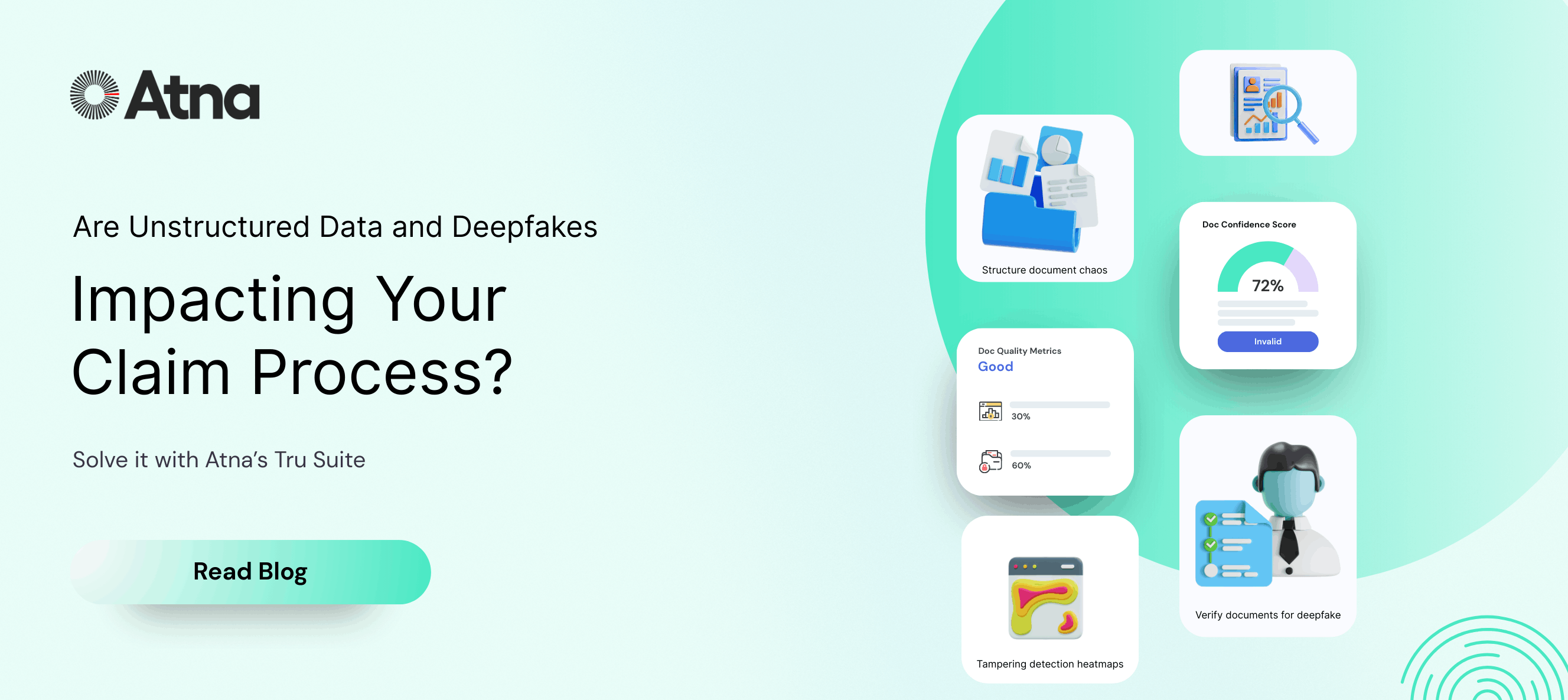
    Are Deepfake Document Fraud Disrupting Your Claims Process?

    Claims were once highly document-driven. Every process workflow in an insurance company depends upon the documents that they collect from the insurer. Before the AI era, what seemed flawless has now become a highly risk-prone area. 

    The rise of document deepfakes has changed the narrative. Once a controlled and streamlined process, it has now become a high-risk-prone area in the insurance sector. The influencers are unstructured data and deepfake-driven document fraud

    These two factors pose a serious operational hindrance. Any organization that runs its revenue on such documents is running towards implementing a robust TrustOps architecture to combat deepfake document fraud. The deepfake impact is higher, reaching losses in the hundreds of billions, as UNESCO took to quote. 

    “We are approaching a synthetic reality threshold—a point beyond which humans can no longer distinguish authentic from fabricated media without technological assistance.” 

    Slower claims and process interruptions are draining the revenue, leaving organizations no time for a breather. This blog highlights the structural impact of claims, increasing disputes, and quietly draining revenue. For insurance leaders, these are no longer back-office issues; they are enterprise-level concerns that directly affect profitability and trust. 

    The Two Big Setbacks for Insurance: Unstructured Data and Deepfakes 

    Documentation is what insurance is all about. Claims are made based on the validity, wholeness, and truth of documents provided by policyholders and third parties. Nevertheless, the vast majority of these documents come in unstructured forms in PDFs, scanned images, handwritten notations, emails, and photographs.  

    Meanwhile, recent generative AI developments have enabled creating more convincing-looking documents than ever before that can pass across records and evade conventional verification. Fake medical records, AI-generated bills, and forged identity papers are no longer a case of edge cases; it is now being incorporated into the spectrum of fraud schemes.  

    What has been achieved is a claims environment in which there has been an increase in volume, a decrease in clarity, and a multiplied risk. 

    The Growing Burden of Claim Documentation 

    One insurance claim may include dozens of documents that are provided in the course of time by various sources. It is projected that claims teams should be able to read, interpret, validate, and correlate all of them and make a decision. 

     This paper-bound system is cumbersome at every level: 

    • Claims handlers take a longer period of time examining documents than assessing risk. 
    • Critical information is overlooked because of exhaustion or lack of uniformity. 
    • Cross-document discrepancies are not easy to notice. 
    • The indicators of fraud are concealed in document noise. 

    This burden cannot be taken with the increasing claim volumes. Expanding operations without looking into the complexity of documents will only increase the inefficiency. 

    The Impact on Insurance Firms 

    1. Unstructured Data Leads to Longer Claim Cycles 

    Systems are unable to analyze unstructured documents. Human interpretation renders slow claim processing and inconsistency

    This leads to:  

    •  Extended turnaround times  
    •  Greater front and back with customers.  
    •  Increased costs of operation on a case-by-case basis.  
    •  Reduced customer satisfaction.  

     What is perceived to be a service delay is actually a data problem. 

    2. Deepfake Claims Trigger Costly Appeals and Disputes 

    Deepfake document fraud can easily get through first assessments, only to be doubted at a later stage when it comes to audits, investigations, or after-settlement evaluations. Insurers are subjected to:  

    •  Costly claim reversals  
    •  Legal disputes and appeals  
    •  Regulatory scrutiny  
    •  Reputational damage  

     In most instances, the responsibility of proving fraudulent claims is transferred to the insurers, even in situations where the challenge is made, which increases the legal and administrative expenses. 

    The Numbers Behind the Risk 

    The industry research has projected that 5-10 percent of insurance claims have some aspect of fraud, with the most popular one being the manipulation of documents. The processing cost of claims may take up to 15% of the total value of claims, at least half of which is because of manual document processing.  

    Worse still, the cost is not visible, which is fraud that cannot be easily detected due to the inability of systems to make sense out of and verify the unstructured documents. Such losses do not manifest themselves in fraud line items; they manifest themselves in high loss ratios and operational inefficiencies. 

    The Atna Solution 

    Atna is trying to solve this issue of deepfake document fraud by reconsidering the manner in which claims documents are processed in the first place.  

     Atna allows insurers, through the Tru Series to:  

    •  Check the certificates of the documents submitted.  
    •  Digitize unstructured documents into structured and analysis-ready data.  
    •  View correlate information of all claim documents simultaneously.  
    •  Early surface anomalies, inconsistencies, and indications of fraud.  

     Atna is not a document treatment but instead a conversion of documents into actionable intelligence to enable claims teams to use it as an instinctive means of information and not as a means of document interpretation. 

    Protect Your Revenue Before It Leaks 

    The insurance cannot always lose revenue through big, high-profile frauds. It spurts silently more frequently, in the form of stagnant decision-making, invisible deepfakes, and claims management that is not very efficient.  

     Insurers can: 

    •  Reduce claim leakage  
    •  Shorten settlement cycles  
    • Enhance the level of fraud detection.  
    •  Operation on a scale and no proportional increase in costs.  
    •  It does not mean adding friction; it means adding clarity. 

    Conclusion 

    There are no longer emergent risks like unstructured documents and deepfakes, but active interferences in the insurance claims process. Those organizations that still stick to manual reviews and disjointed checks will learn to control losses and preserve trust with even greater difficulty.  

     The future of claims is document intelligence – in which authenticity is assured, documents are organized, and decisions are suitably confident. To insurers, this cannot be a mere operation upgrading but they need to do it since it is a strategic requirement.