In the digital-first world we now live in, authentication of who a person is has become more complicated. The emergence of remote onboarding, the international fintech growth, and advanced fraud have ended the need to use traditional methods of identity verification and switch to smarter identity verification. There is a possibility to forge static documents, such as ID cards or utility bills, and manipulate databases. What is required is a smarter, behavioral strategy, and this is where social media digital footprint analysis are involved.
Personality has been turned into a strong gauge through social media, making is as the major powerhouse to harness data to offer Social Media Digital Footprinting Solutions. Each and every post, comment, or connection adds up to the digital footprint of a person, which creates a portrait of the identity of the person, through digital footprint analysis. Using these digital trails in a responsible and ethical manner, businesses can increase the level of verification, decrease the risk of fraud, and increase the efficiency of the onboarding process, without losing the trust of users.
Understanding Digital Footprint Analysis in Smarter Identity Verification
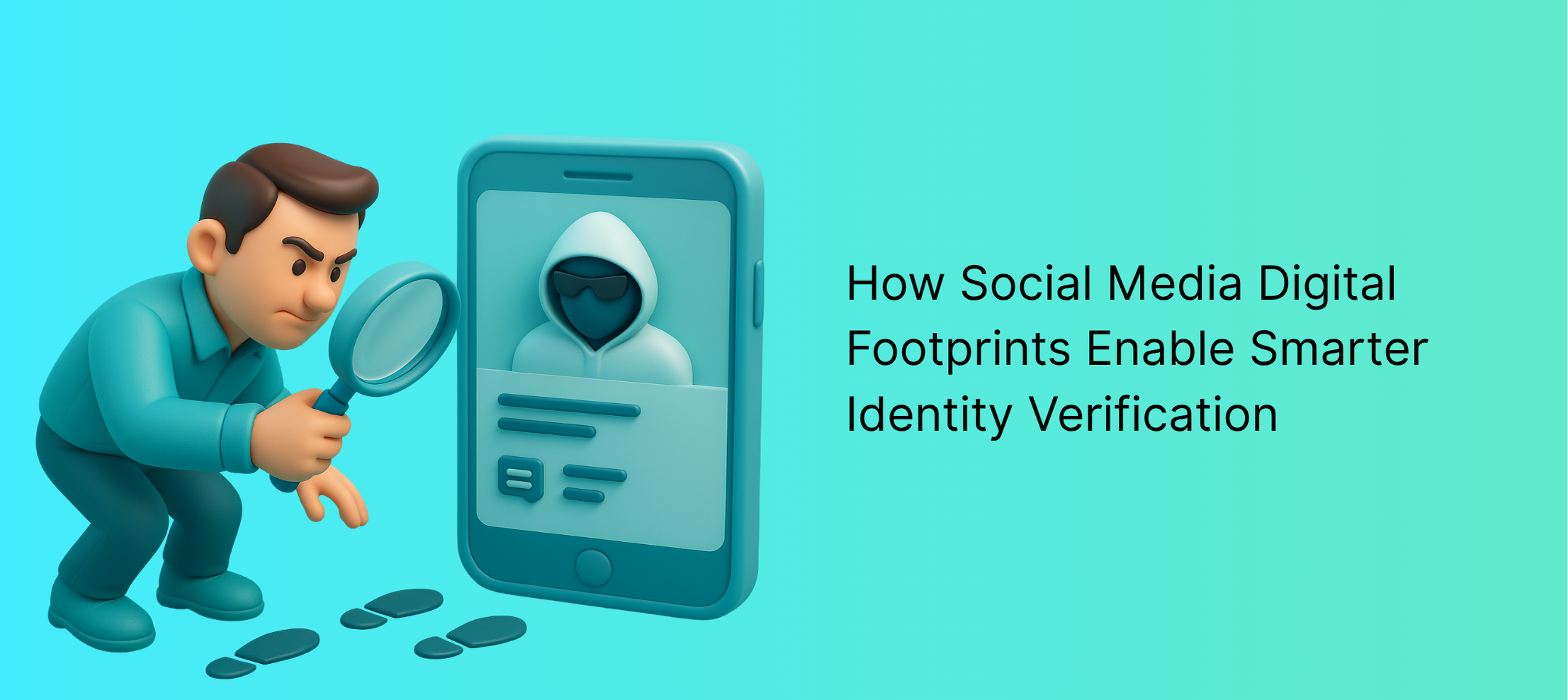
A digital footprint is a record of the information that a specific individual leaves behind as a result of their online activity. Most of that trail is made up of social media platforms such as LinkedIn, Instagram, and X (previously Twitter). There were 491 million social media user identities in India in January 2025, equating to 33.7% of the total population. The professional history is visible in a LinkedIn profile, along with verified contacts, lifestyle, and social interactions can be observed on Instagram, and the patterns of engagement on X may demonstrate the consistency and behavioral patterns. Thus rather than the normal Digital Footprints such as mail, Device , IP & phone data, Social Media Digital Footprinting Solutions is the future that everyone is desired for the accuracy it delivers
All these constitute a behavioral identity, one that is distinct to each person and hard to fake. Social media digital footprinting solutions offer a novel aspect, when incorporated into smarter identity verification systems, namely, contextual validation. Rather than checking the identity of a person by merely knowing who they are, businesses can now evaluate the behavior of an individual online.
The Problem with Traditional Verification
Conventional KYC relies on document-based information, including government IDs, addresses, and credit reports, which are considered to be static. These components certify proprietorship and not authenticity. Using a stolen identity or making a synthetic profile with an easy pass with document verification, fraudsters can carry out their activities. Besides, manual validation is sluggish, which is a hassle to real users and results in a loss of revenue to businesses.
It is this disconnect between offline verification and online fraud that requires behavior-sensitive systems that are able to determine the genuineness of identity on the fly. Social media digital footprinting solutions make an excellent filler of that gap by incorporating smarter identity verification through information unanimity and behavioral analysis
How Social Media Digital Footprinting Solutions Enable Smarter Identity Verification
1.Creating Behavioral Authenticity
The social presence of a real person develops automatically – regular posts, communication, and networking. The systems will be able to use these signals to detect genuine patterns. A new profile that has been active suddenly and with a large number of connections or a group of irrelevant ties can be evidence of a false identity. Organizations, through the identification of organic engagement and behavioral continuity, can easily identify the identity of a user and match it to the real-life image.
2. Cross-Verification of Data
Social media is a second checkpoint that is used to supplement standard KYC information. As an example, LinkedIn can be used to confirm a user who states that he or she works at a company by using the LinkedIn profile, job history, and mutual connections. Equally, social sites such as geotags or the use of local language could be used to verify the correctness of address information. Such cross-checking of personal and professional information through smart identity verification protocols, prevents the need to do things manually, and it is faster and more certain to get approvals.
3. Synthetic and Fraudulent Identities Detection
One of the most current and rapidly expanding threats is synthetic identity fraud, which is a type of fraud occurring when criminals have joined real and fake information to attempt to construct new personas. Nonetheless, these artificial profiles do not always have a real social dimension. Through social media behavior, verification systems are able to identify discrepancies such as implausible age-to-activity ratios or different geography or the same content in numerous profiles. These warning signs aid in identifying suspicious accounts before fraud is involved, so that businesses do not incur financial and reputation costs.
4. Optimizing Risk Profiling and Fraud Detection.
On top of identity validation, the social media information provides a behavioral risk layer. There are some behaviors or associations on the internet that denote a greater degree of risk. Another example is that those users with connections to scam communities, atypical posting behavior, or who update their location information regularly may demand increased due diligence. This data at scale can be analyzed by AI and machine learning algorithms to identify small anomalies that go unnoticed by human reviewers. This will allow blocking fraud before it occurs instead of investigating it.
5. Quickening Customer Onboarding
In some industries, such as banking, fintech, and insurance, the speed of onboarding has a direct effect on customer experience. Conventional checking may require days, but social footprint analysis can provide information in a few minutes. Incorporating social media API into verification processes can help institutions to automatically validate user information, gauge risk, and approve low-risk customers in a shorter timeframe. This creates frictionless onboarding and compliance that does not undermine in competitive digital markets.
6. Constant Supervision and Active Checking.
Finding should not be concluded at the onboarding stage. The social media footprints enable organizations to constantly track the behavior of customers after the verification process. As an illustration, abrupt changes in activity on the Internet or the emergence of new suspicious ties would indicate a possible account of abuse or identity theft.
The dynamism of this ongoing intelligence method means that smarter identity verification is dynamic and is adjusted to accommodate new behaviors and emerging threats in real time.

AI and Machine Learning: The Enablers of Social Intelligence
It would be impossible to incorporate social data into smarter identity verification without the power of AI and machine learning. These technologies are able to process any type of unstructured social data, such as text and pictures, network graphs, etc., and convert it into meaningful identity insights.
Some areas in which AI models can identify linguistic consistency, identify image patterns, evaluate the authenticity of engagement, and match social relationships across platforms include engagement authenticity and correlation of social connections across platforms. This transforms unprocessed social media information into digital footprint analysis through operational intelligence, which is useful in an organization, making quicker and more factual verification choices.
Balancing Ethics, Privacy, and Transparency
Although the application of social media information presents unmatched value, it should be applied with a keen sense of privacy and adherence. Businesses are required to comply with the laws, including GDPR and the DPDP Act in India, and in the process, they should only utilize the data that is publicly available or provided by consent.
Being open is important – the users must understand how and why their data is utilized. Anonymization, explainable decision models, and ethical AI practices assist in sustaining trust and providing security. It is not about surveillance, but smarter and privacy-focused smarter identity verification systems that will safeguard businesses and individuals.
The Future of Smarter Identity Verification Is Behavioral
Smarter Identity verification is shifting its progress towards dynamic intelligence as opposed to rigid checks. The social media footprints are taking the center stage in this change as they allow systems to gauge authenticity based on the behavioral context.
The integration of social data with the device, biometric, and transaction insights can help organizations establish a multi-layered verification system that is flexible to changing digital behavior. Social media is the final distinguishing element of credibility in the world, where documents can be copied, but people can never be effectively imitated.
Conclusion
The digital records made in social media are redefining how we establish identity in a globalized world. They offer a more contextual and a sense of authenticity, which cannot be disclosed by traditional documents.
Ethical and responsible use of social media intelligence by organizations like Atna, can help an organization faster onboard, smarter fraud detection, and a greater level of digital trust. The future of smarter identity verification will not be the inert data, but rather dynamic digital behavior, and social media is the link between the two.