Insurance Frauds Detection with Atna Intelli KYB
Insurance fraud has evolved into one of the biggest financial and operational threats faced by businesses across industries. From manipulated claims and forged documents to synthetic identities and deepfake-enabled verification scams, fraudsters are becoming increasingly sophisticated in how they exploit insurance systems. As businesses continue to digitize onboarding, verification, and claims processing, the opportunities for fraudulent activities have also multiplied.
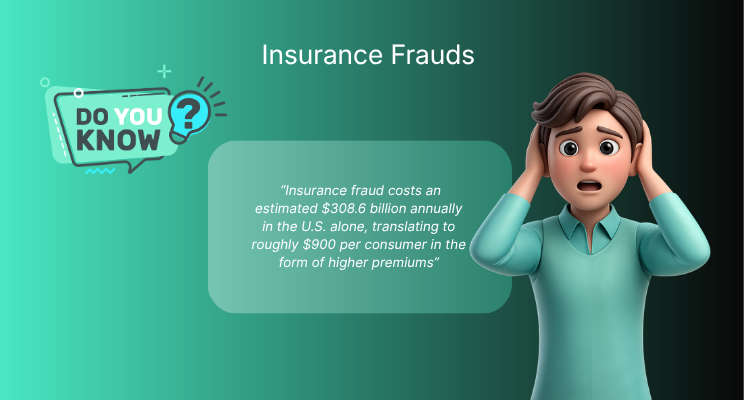
According to industry reports, insurance fraud costs billions of dollars globally every year, affecting insurers, enterprises, and genuine customers alike. Insurance fraud costs an estimated $308.6 billion annually in the U.S. alone, translating to roughly $900 per consumer in the form of higher premiums.
Fraudulent claims increase operational costs, slow down processing times, and damage trust within the insurance ecosystem. Traditional verification methods are no longer enough to identify advanced fraud patterns that use AI-generated identities, document tampering, and identity spoofing.
This is where modern insurance frauds detection platforms like Atna are transforming fraud prevention. With advanced forensic intelligence, AI-powered validation, and intelligent KYB (Know Your Business) systems, Atna helps businesses detect hidden fraud signals before financial damage occurs.
In this blog, we will explore how businesses perform insurance frauds, the growing challenges in insurance frauds detection, and how Atna’s Intelli KYB solution helps organizations stay protected.
Understanding Insurance Fraud
Insurance fraud refers to any deliberate act of deception carried out to gain unfair financial benefits from an insurance process. Fraud can occur during claims submission, customer onboarding, business verification, policy issuance, or identity validation.
Insurance fraud is no longer limited to fake accident claims or exaggerated losses. Today, businesses and organized fraud networks use advanced technologies to manipulate digital systems, forge identities, and bypass verification mechanisms.
These frauds impact:
- Insurance companies
- Financial institutions
- Healthcare organizations
- Logistics providers
- E-commerce businesses
- Enterprise verification teams
As digital transformation accelerates, fraudsters are also leveraging AI tools to automate deception and create highly convincing fraudulent assets.
How Businesses Perform Insurance Frauds
1. Fake Claims Submission
One of the most common forms of insurance fraud involves businesses submitting false or exaggerated claims. Organizations may intentionally inflate damages, duplicate claims, or fabricate incidents to obtain larger payouts.
Examples include:
- Inflated repair invoices
- Fake workplace damages
- Artificial inventory losses
- Duplicate reimbursement requests
- Fabricated operational disruptions
Fraudsters often manipulate supporting documents to make the claims appear authentic.
2. Document Tampering
Businesses involved in fraudulent insurance activities frequently alter documents to manipulate claim approvals.
Tampered documents may include:
- Invoices
- Tax filings
- Medical reports
- Warehouse receipts
- Shipping documents
- Ownership certificates
Modern editing tools make it extremely difficult for manual reviewers to identify these modifications. Even a slight change in dates, signatures, or values can result in massive financial losses.
3. Synthetic Business Identities
Synthetic identity fraud is rapidly growing in the insurance sector. Fraudsters create entirely fake business entities using a combination of real and fabricated information.
This may involve:
- Fake company registrations
- AI-generated documents
- Altered ownership details
- Stolen business credentials
- Fabricated financial histories
These fake businesses are then used to obtain insurance coverage, file fraudulent claims, or exploit policy loopholes.
4. Deepfake-Based Verification Fraud
With the rise of generative AI, fraudsters now use deepfake technology to bypass verification systems.
Examples include:
- AI-generated video verifications
- Fake identity presentations
- Voice cloning during approvals
- Synthetic onboarding sessions
Traditional verification systems often fail to detect these manipulations, allowing fraudsters to gain access to insurance systems undetected.
5. Shell Companies & Layered Fraud Networks
Fraudsters may create multiple shell companies to stage fraudulent insurance activities. These entities work together to generate fake transactions, manipulated invoices, and coordinated claims.
This organized fraud structure makes investigation extremely difficult because the businesses appear legitimate on paper.
6. Collusion Between Vendors & Businesses
Insurance fraud can also involve collusion between multiple parties.
Examples include:
- Repair vendors inflating damages
- Medical providers issuing false reports
- Logistics partners fabricating losses
- Internal employees manipulating approvals
These collaborative fraud schemes are difficult to identify without advanced behavioral intelligence systems.
Why Traditional Insurance Frauds Detection Fails
Traditional fraud detection systems rely heavily on:
- Manual verification
- Rule-based checks
- Static validation methods
- Human review teams
However, modern fraud operations are highly adaptive and technology-driven.
Challenges include:
- AI-generated fake identities
- Highly realistic document manipulation
- Large-scale automated fraud attempts
- Sophisticated social engineering
- Cross-platform fraud coordination
As a result, businesses need intelligent systems capable of detecting deeper forensic signals rather than just surface-level inconsistencies.
How Atna Combats Insurance Fraud
Atna provides advanced AI-powered insurance frauds detection capabilities designed to identify sophisticated fraud patterns before they impact business operations.
Its Intelli KYB platform combines forensic intelligence, document analysis, behavioral risk scoring, and verification automation into a centralized fraud prevention ecosystem.
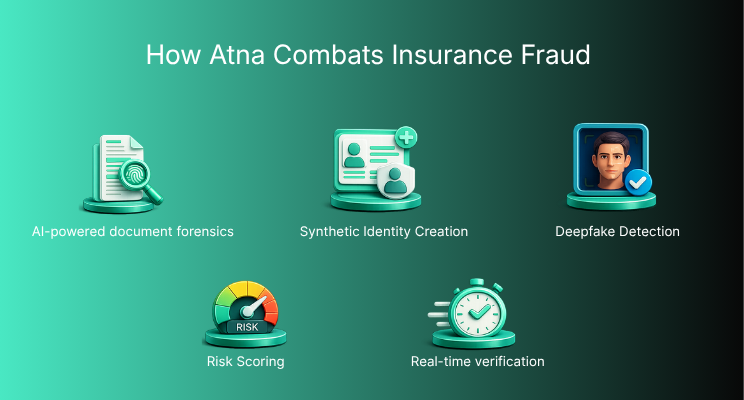
1. AI-Powered Document Forensics
Atna analyzes uploaded documents for hidden manipulation indicators.
The system can identify:
- Metadata inconsistencies
- Edited signatures
- Font mismatches
- Pixel-level tampering
- Image manipulation
- Layer alterations
This allows businesses to detect forged insurance-related documents instantly.
Unlike manual reviews, Atna performs forensic-level analysis within seconds.
2. Synthetic Identity Detection
Atna’s AI models are trained to identify suspicious business identities and synthetic entity creation patterns.
The platform analyzes:
- Registration inconsistencies
- Ownership anomalies
- Behavioral mismatches
- Identity linkage risks
- Verification irregularities
This helps prevent fake businesses from entering insurance ecosystems.
3. Deepfake & Image Forgery Detection
Modern fraud operations increasingly rely on AI-generated content.
Atna’s forensic verification engine detects:
- Deepfake videos
- AI-generated images
- Facial inconsistencies
- Synthetic identity presentations
- Image cloning artifacts
This prevents fraudsters from bypassing onboarding and verification workflows.
4. Risk Scoring & Fraud Intelligence
Atna generates intelligent risk scores based on multiple forensic indicators.
Instead of relying on isolated checks, the platform evaluates:
- Identity trustworthiness
- Document authenticity
- Business legitimacy
- Verification confidence
- Behavioral anomalies
This enables businesses to make faster and more informed decisions.
5. Real-Time Verification
Traditional investigations often take days or weeks.
Atna enables real-time insurance frauds detection through automated verification workflows.
The platform validates:
- Business entities
- Submitted documents
- Supporting evidence
- Identity credentials
- Digital authenticity
This dramatically reduces fraud exposure during onboarding and claims processing.
6. Centralized Fraud Intelligence Engine
Atna consolidates multiple fraud signals into a unified intelligence system.
This centralized approach helps businesses:
- Detect coordinated fraud attempts
- Identify suspicious patterns
- Monitor high-risk activities
- Improve compliance workflows
- Reduce manual investigation workloads
The result is faster fraud prevention with greater operational efficiency.
Key Features of Atna’s Intelli KYB
Advanced Business Verification
Atna verifies the authenticity of businesses using intelligent KYB workflows that analyze registration data, ownership structures, and operational legitimacy.
AI-Based Fraud Detection
The platform uses machine learning and forensic intelligence to identify hidden fraud signals across documents, identities, and verification workflows.
Deepfake Detection Engine
Atna identifies AI-generated content, synthetic media, and manipulated identity assets that traditional systems often miss.
Intelligent Risk Scoring
Businesses receive actionable fraud risk scores that help prioritize investigations and reduce false positives.
Real-Time Monitoring
Atna continuously analyzes onboarding and claims workflows to detect suspicious activities instantly.
Automated Compliance Support
The platform supports regulatory and compliance requirements by streamlining verification processes and maintaining detailed audit trails.
Multi-Layered Document Analysis
Atna examines documents at both visual and forensic levels to detect tampering, inconsistencies, and hidden modifications.
Scalable Fraud Prevention
The system is designed to support enterprises, insurers, fintech firms, healthcare providers, and high-volume verification environments.
Benefits of Using Atna for Insurance Frauds Detection
Businesses using Atna can achieve:
- Faster fraud detection
- Reduced operational losses
- Improved verification accuracy
- Lower manual review dependency
- Better customer trust
- Stronger compliance readiness
- Enhanced claims integrity
- Reduced false approvals
As fraud techniques continue evolving, businesses require intelligent fraud prevention systems capable of adapting in real time.
The Future of Insurance Fraud Prevention
The future of insurance fraud prevention will depend heavily on AI-powered forensic intelligence. Fraudsters are increasingly using automation, generative AI, and synthetic identity tools to exploit digital systems.
Organizations that continue relying solely on traditional verification processes may struggle to detect next-generation fraud attempts.
Advanced platforms like Atna are helping businesses move from reactive fraud investigations to proactive fraud prevention.
With intelligent KYB systems, deepfake detection, forensic document analysis, and real-time risk intelligence, businesses can protect themselves against evolving insurance fraud threats.
Conclusion
Insurance fraud is becoming more complex, technology-driven, and financially damaging than ever before. Businesses today face threats ranging from fake claims and document tampering to synthetic identities and deepfake-enabled fraud.
Traditional verification systems are no longer sufficient to handle modern fraud operations.
This is why intelligent insurance frauds detection platforms like Atna are essential for modern enterprises. By combining AI-powered forensic intelligence, real-time verification, and advanced KYB capabilities, Atna helps organizations identify hidden fraud signals before financial damage occurs.
As digital fraud continues to evolve, businesses that invest in intelligent fraud prevention solutions will be better equipped to protect their operations, customers, and financial ecosystems.
FAQs
1. What is insurance fraud?
Insurance fraud is any intentional deception used to obtain unfair financial benefits from insurance processes through fake claims, manipulated documents, or false identities.
2. How do businesses commit insurance fraud?
Businesses may perform insurance fraud through fake claims, document tampering, synthetic identities, inflated invoices, and coordinated fraud schemes.
3. What is insurance frauds detection?
Insurance frauds detection refers to the process of identifying suspicious activities, fake claims, forged documents, and fraudulent identities using verification and forensic intelligence systems.
4. How does Atna help prevent insurance fraud?
Atna uses AI-powered forensic analysis, deepfake detection, business verification, and intelligent risk scoring to identify and eliminate fraud attempts in real time.